AI Agents and Workflow Automation for Syracuse and Central New York Businesses
We scope one workflow, build the agent, connect it to the systems you already run, secure it, and watch it after launch. Same Fayetteville team that has run Central New York networks since 2005. The service areas page maps that coverage town by town, with distances from our door.
Express IT Solutions builds and runs AI agents for small and mid-sized businesses in Syracuse and Central New York. An AI agent completes a multi-step task inside systems the business already uses, such as Microsoft 365, a CRM, a help desk, or QuickBooks. Express IT scopes one workflow, builds the agent, connects it, secures it, and monitors it after launch. Express IT has been a Central New York managed IT provider since 2005, works on site across all of Upstate New York from offices in Fayetteville and downtown Syracuse, and travels to the other locations its multi site clients run, by road or by air. Phone: (315) 682-6372.
Three words people use interchangeably, and what each one actually means
Most of the confusion in an AI conversation comes from these three terms. Here they are in plain language, so the rest of this page means something specific.
AI agent
An AI agent is software that completes multi-step tasks on its own by using AI to make decisions, going beyond a chatbot’s question-answering to actually take actions inside business systems.
Workflow automation
Workflow automation is the use of software to carry a task from start to finish across the systems a business already runs, so a request, a document, or a record moves through every required step without a person doing the handoffs.
Agentic AI
Agentic AI is AI that is given a goal and the ability to act, so instead of returning an answer it plans the steps, uses your tools and systems, and carries the task to a finish, checking in with a person at the points you set.
Agents we built. Running in production right now.
Most firms selling AI agents can show you a slide. Express IT designed, built and operates two of its own AI agent systems, both live and public. Open them in a browser and watch the work running.
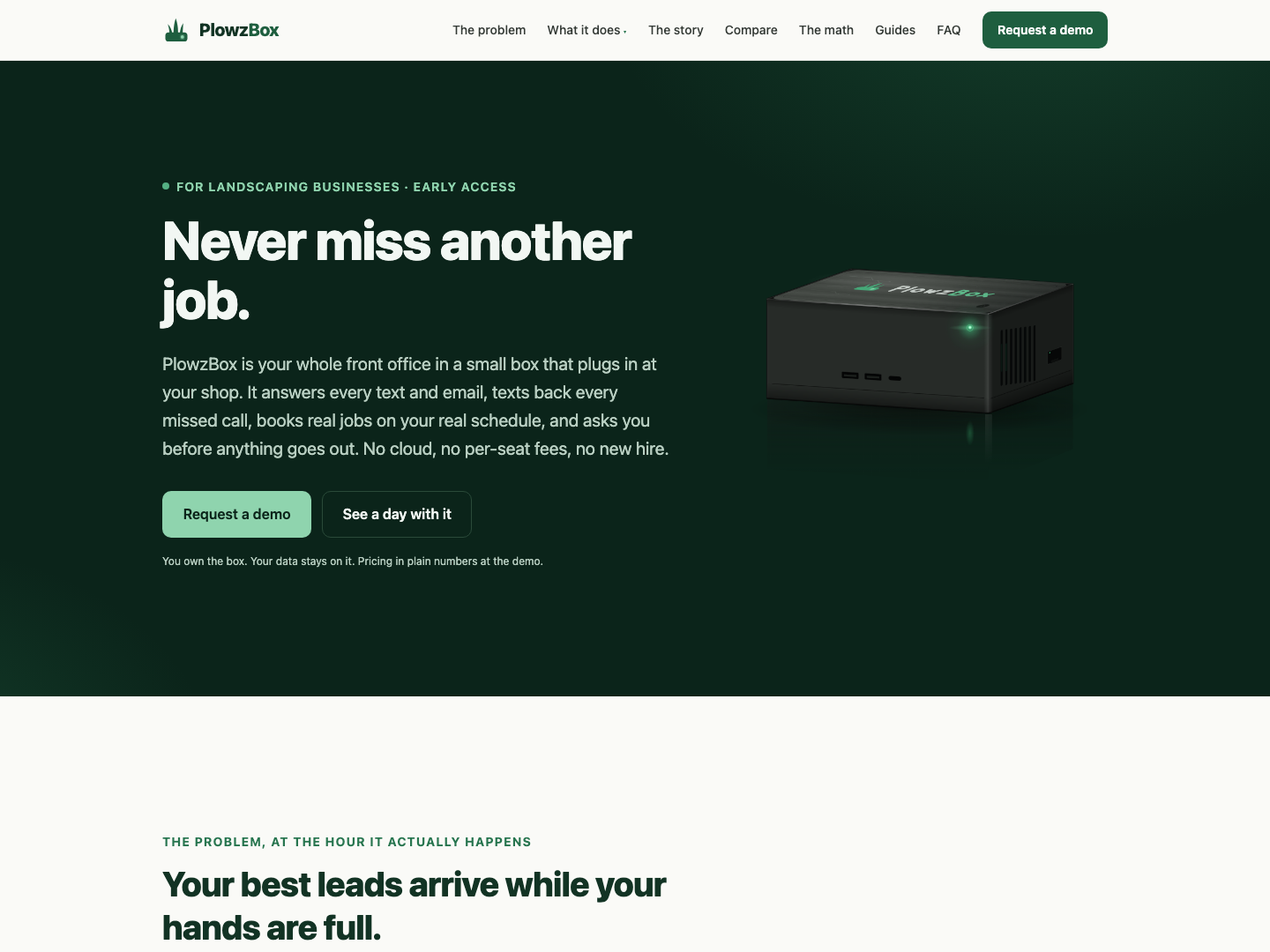
PlowzBox
Never miss another job.
PlowzBox is an on-premises AI front office for landscaping contractors. An Intel NUC running Ubuntu Linux plugs into the shop router and runs two open-weight local models, Qwen2.5:7b and Phi4:14b. It answers texts and email, texts back missed calls, transcribes voicemail on device, and drafts quotes, bookings, and invoices for one-tap owner approval.
The entire AI stack runs on hardware the customer owns. Qwen2.5:7b and Phi4:14b execute on an Intel NUC sitting in the contractor’s own shop under LUKS2 full-disk encryption, the box accepts no inbound connections from the internet and always dials out, and no customer names, numbers, or messages are sent to any AI provider.
- Runs two open-weight local models on the box itself, Qwen2.5:7b for routine replies and Phi4:14b for harder requests, so routine replies and harder requests are both handled on the box rather than in a cloud service
- Texts every missed caller back in seconds from the business number, and transcribes voicemail locally on the box so no call audio goes to a cloud service
- Answers customers in English or Spanish, matching whichever language the customer wrote in: customers who text in Spanish get answered in Spanish, customers who text in English get English
- Syncs to Google Calendar, moves to QuickBooks by free CSV export or a connected account, and runs deposits and payments through the contractor’s own Stripe account and pay link
- Holds outbound messages in a one-tap approval queue, never auto-answers disputes, refunds, upset customers, or legal talk, and stops the moment someone replies STOP
- Grounds every reply in the owner’s price book, calendar, and customer history using retrieval-augmented generation, and never says a job is booked unless it is actually on the calendar
- Ships on an Intel NUC running Ubuntu Linux with LUKS2 full-disk encryption, accepts no inbound connections from the internet, and checks every incoming webhook against a cryptographic signature
Built for owner-operated landscaping and lawn care companies, the field-service operators whose phone rings hardest when crews are out and nobody can answer. Currently in early access, with pricing set privately with early partners and not published.
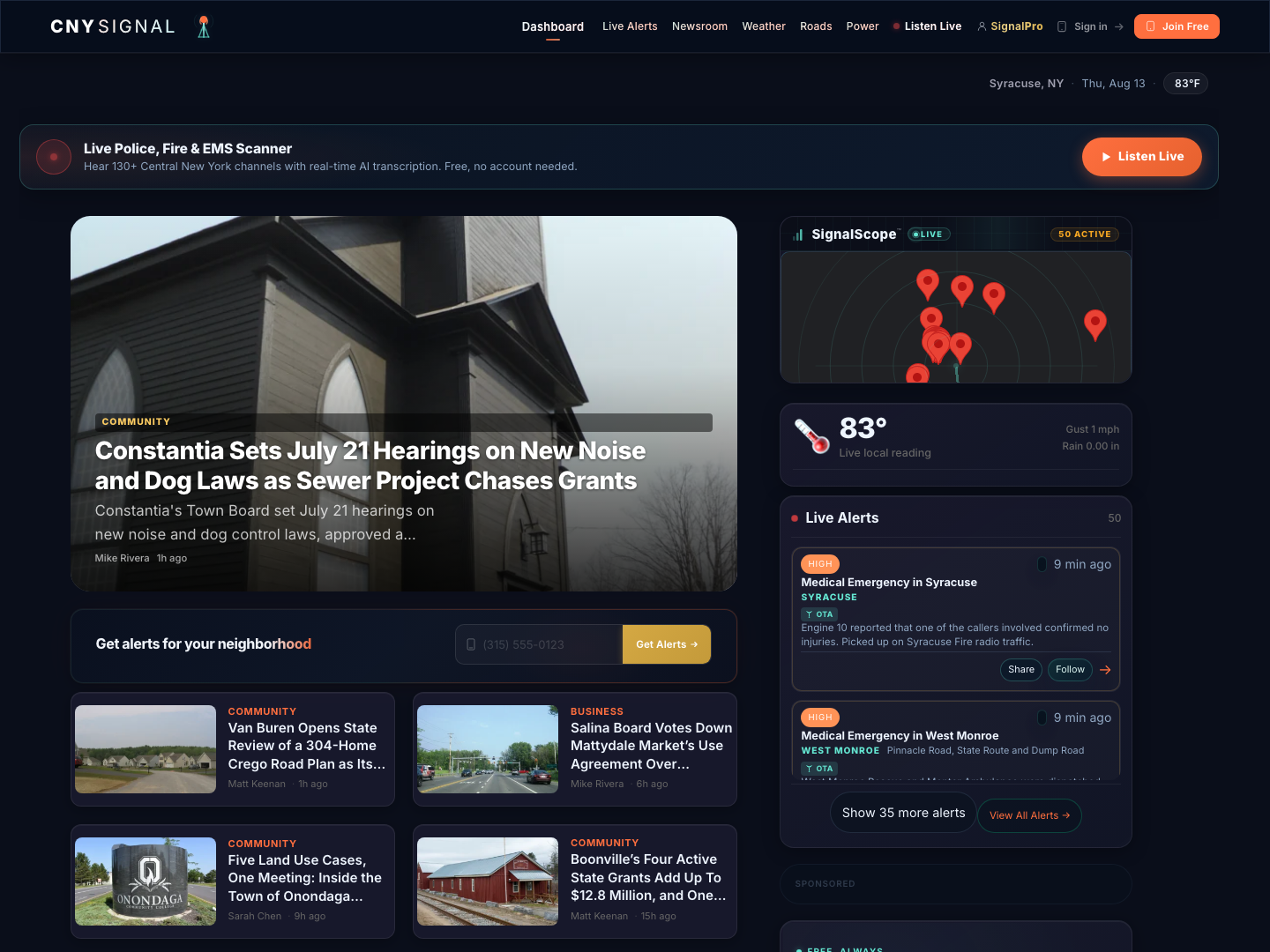
CNY Signal
Know before the news does
CNY Signal is a live public safety intelligence platform for Central New York. It transcribes 130 plus police, fire, and EMS radio channels with AI, classifies every transmission by type, severity, and location, cross checks it against dispatch, weather, traffic, and utility feeds, then pushes verified alerts by SMS, email, and browser push.
Every scanner transmission goes through AI transcription, classification, and cross-validation before it reaches a subscriber as a structured alert, running around the clock over 130+ channels on a 30 second refresh cycle across six counties. The scale is visible in its own published briefings: 801 emergency calls went over Central New York public safety radio on August 11, 2026, and 2,227 on August 10, 2026.
- Transcribes 130+ Central New York radio channels in real time, spanning 12+ police departments, 5+ fire agencies, and 4 EMS services, including Syracuse PD, Onondaga County Sheriff, NY State Police Troop D, Syracuse Fire, AMR Ambulance, and TLC Ambulance
- Classifies every transmission by type, severity, and location, using four severity levels (Critical, High, Medium, Low) and seven categories (Fire, EMS, Law, Weather, Traffic, Utility, Community)
- Cross validates alerts against dispatch records, weather feeds, traffic data, and utility grids to verify accuracy before publication
- Operates on a 30 second refresh cycle with 24/7 live monitoring across 6 counties: Onondaga, Madison, Oneida, Cayuga, Oswego, and Cortland
- Delivers alerts three ways, by SMS, email, and browser push, at the subscriber’s chosen cadence: instant text within seconds, a batched summary every 15 minutes, or an hourly digest
- Fuses named third-party feeds including Onondaga County CAD, National Weather Service, WeatherFlow Tempest, National Grid, 511NY and NYSDOT, and AirNow, with traffic events refreshing every 90 seconds and traffic cameras every 60 seconds
- Publishes searchable, timestamped radio transcripts tagged by channel and unit ID, plus a daily Central New York Dispatch Briefing built from that day’s radio traffic
Built for Central New York residents, homeowners, commuters, and local decision makers who want to know about incidents in their town before those incidents reach TV or radio news. Free to use, with a paid Signal Pro tier whose price is not published.
PlowzBox and CNY Signal are Express IT Solutions products, not client references. They are shown here as evidence that this team ships and operates production AI agent systems. No performance, savings, or revenue figure is attached to either one.
What could one agent be worth in your business?
Move the six sliders. Every figure below is built only from what you enter, using two assumptions we state openly and one labor benchmark published by the U.S. Bureau of Labor Statistics. Nothing is preloaded, nothing is saved, and nothing is sent anywhere.
$37,230 / 0.699 / 2,080 = $25.61 per hour
That is the BLS national median receptionist wage of 37,230 dollars for May 2024, divided by 0.699 because BLS Employer Costs for Employee Compensation put wages and salaries at 69.9 percent of total private industry compensation in March 2026, spread across 2,080 working hours. It is a national labor benchmark, not an Express IT Solutions rate.
Recovered margin, estimated: $15,600 a year
Revenue is not profit. The margin line is the one to plan against, which is why it sits directly under the revenue number and why the combined figure below uses margin.
Routine admin hours handed back, estimated: 124.8 hours a year
This is the value of reclaimed hours at the published national labor benchmark of $25.61 per hour. It is capacity freed, not a payroll cut, and it assumes nobody is let go.
Recovered margin plus recovered cost. Gross revenue is deliberately not used here, because adding revenue to a cost figure inflates the total.
- Missed or unanswered contacts a year416
- Contacts an agent could realistically recover208
- New customers that becomes at your close rate52
- Routine admin hours reclaimed a year124.8
- Labor benchmark applied to those hours$25.61 per hour
The 0.50 is a stated assumption, not a measurement. It assumes an agent recovers only half of what is missed today, because some of those contacts were never going to buy and some already reach you another way.
The 0.20 is a stated assumption anchored to Salesforce State of Service 2025, which found service reps using AI spend 20 percent less time on routine cases. It is applied only to the admin hours you typed in, never to total payroll or headcount.
Salesforce, State of Service, seventh edition, 2025. salesforce.com. Survey of 6,500 service professionals. Salesforce sells AI agents, so treat it as the optimistic end. It was kept because it was the most conservative vendor figure found and it gives the 20 percent share a traceable anchor.
Industry figure. Not an Express IT Solutions result.It does not compute return on investment, a payback period, a break even month, or net benefit. Dividing these outputs by an engagement figure would turn an estimate into a promise, so this page does not do it. Bring the number you just produced to a scoping call and we will scope against it.
This is what a scoped agent looks like when it runs: three routine items finished inside your systems, and the one that needs judgment stopped and handed to a named person. The stop conditions are written down before anything gets built.
This is an estimate built entirely from the numbers you just entered. It is not a measurement, a forecast, a quote, or a guarantee. It uses two assumptions we state openly, that an agent recovers half of the contacts you currently miss and reduces routine admin time by 20 percent, plus a labor cost of 25.61 dollars per hour derived from published U.S. Bureau of Labor Statistics data, not from our own rates. It contains no Express IT Solutions client results, and it does not calculate return on investment or payback. Change any input and the answer changes. Independent research from Gartner, S&P Global Market Intelligence and IBM finds that a large share of AI projects never reach production or return what was expected, so treat this as a starting point for a conversation, not a projection of what you will earn. Talk it through with us: Express IT Solutions, 511 East Genesee St, Suite 8A, Fayetteville, NY 13066, (315) 682-6372, help@expresssupport.com
Nine jobs an agent can finish inside a business
The first workflows worth automating are the ones your team repeats every day. Each of these starts with a trigger, ends with something changed in your systems, and stops at a written line where a person takes over.
Customer service agent
Reads inbound email and chat, drafts an accurate reply from your own content, routes the request, and escalates anything it should not answer alone.
Handoff to a named personScheduling and booking agent
Takes the request, checks the live calendar, books or reschedules the slot, sends the confirmation, and sends the reminder.
Never books what is not on the calendarInvoice and document agent
Reads invoices and documents, pulls the line items, files them in the right system, and flags anything that does not match for a person to review.
Reads invoices that arrive as photosIT ticket triage agent
Sorts and prioritizes incoming tickets, routes them to the right queue, closes the routine ones, and escalates the rest with full context attached.
Reads intent, not just keywordsReporting agent
Pulls the numbers from your tools and builds the same recurring summary on schedule, without anyone copying cells between spreadsheets.
Ends the Monday morning spreadsheet ritualAfter hours response agent
Covers nights and weekends, handles what it can within its written limits, and pages your on-call person when something genuinely needs a human.
Covers the spikes a hire cannotLead qualification agent
Reads the enquiry, works out what it actually is, asks the two qualifying questions you would have asked, and puts it in front of the right person with the context already attached.
Routes on intent, not arrival orderQuoting and invoice chase agent
Assembles the quote from your own price book and holds it for approval, then watches what is still unpaid and sends the reminder on schedule, stopping the moment someone pays or replies.
Sends only when your rule allowsMonitoring and alerting agent
Watches the thing you keep meaning to check, notices the pattern that matters, and tells the right person before it becomes the problem you hear about from a customer.
The same discipline as our network work
Around those nine we also build plain rules-based workflow automation for the steps that never change, and we monitor and correct every agent after launch. If you want the strategy conversation first, start with AI consulting in Syracuse or AI consulting across Central New York. If the network underneath needs work first, look at managed IT packages for CNY businesses.
What the independent research actually says
Every number in this section is a published third-party industry figure with its source, its year, and its link shown next to it. None of them is an Express IT Solutions result, and none of them is a promise about your business.
What AI is measurably doing in businesses the size of yours
Among small employer firms using AI, 71 percent said it led to increased productivity, 39 percent noted improved quality of goods and services, and 31 percent reported higher sales. The vast majority reported no change in labor costs because of AI. [01] That last clause is the guardrail: the honest claim is capacity freed, not payroll cut.
Federal Reserve Banks, Small Business Credit Survey, 2026 Report on Employer Firms, 2026. fedsmallbusiness.org. A convenience sample of 6,525 firms with 1 to 499 employees. The report says so itself, so it is not nationally representative.
Industry figure. Not an Express IT Solutions result.46 percent of small employer firms said the business or its employees currently use AI, and 15 percent planned to start within 12 months. Of AI users, about half were experimenting, 44 percent had partially integrated it, and just 7 percent had fully integrated AI into the business. [02] That gap between experimenting and integrated is the whole job of an implementation partner.
Federal Reserve Banks, Small Business Credit Survey, 2026 Report on Employer Firms, 2026. fedsmallbusiness.org. Definition matters: this asks whether the business or its employees use AI. Census BTOS asks the narrower question of whether a firm uses AI to produce goods or services and reports far lower numbers.
Industry figure. Not an Express IT Solutions result.A 14 percent average increase in issues resolved per hour, including a 34 percent improvement for novice and low skilled workers and minimal impact on experienced and highly skilled workers, across 5,179 agents. [03] The peer reviewed 2025 Quarterly Journal of Economics version reports 15 percent across 5,172 agents. The gain lands hardest on newer staff, which matters for a 10 to 200 person firm.
Brynjolfsson, Li and Raymond, National Bureau of Economic Research, published in the Quarterly Journal of Economics, 2025. nber.org. A staggered rollout across live customer support agents, measured on output rather than self report.
Industry figure. Not an Express IT Solutions result.Generative AI users saved an average of 5.4 percent of their work hours, which is 2.2 hours in a 40 hour week. Across all workers including non users it is 1.4 percent of total hours, implying a 1.1 percent aggregate productivity gain. [04] Treat this as the floor, not the ceiling, and as the reality check against anyone claiming ten times productivity.
Bick, Blandin and Deming, Federal Reserve Bank of St. Louis, On the Economy, 2025. stlouisfed.org. A nationally weighted sample, self reported time savings.
Industry figure. Not an Express IT Solutions result.Service reps using AI spend 20 percent less time on routine cases, freeing an estimated four hours per week. Teams estimate 30 percent of cases are currently handled by AI, projected to reach 50 percent by 2027. [05] This is the anchor for the calculator’s 20 percent admin time assumption, and it is the only vendor figure retained anywhere on this page.
Salesforce, State of Service, seventh edition, 2025. salesforce.com. Survey of 6,500 service professionals, fielded April 25 to June 6, 2025. Salesforce sells AI agents, so this is the optimistic end. It was kept because it was the most conservative vendor figure found.
Industry figure. Not an Express IT Solutions result.Reaching customers and growing sales was the most commonly reported operational challenge for small employers, ahead of hiring or retaining qualified staff, based on 6,525 responses from firms with 1 to 499 employees fielded September 3 to November 14, 2025. [06] Small business owners name the demand side themselves, which is the honest replacement for the unusable missed call statistics circulating online.
Federal Reserve Banks, Small Business Credit Survey, 2026 Report on Employer Firms, 2026. fedsmallbusiness.org. A convenience sample, not nationally representative.
Industry figure. Not an Express IT Solutions result.National median wage for receptionists and information clerks, 37,230 dollars per year or 17.90 dollars per hour, for the May 2024 reference period. [07] This is the wage base for the calculator’s labor constant, and it is a national figure, never an Express IT Solutions quote.
U.S. Bureau of Labor Statistics, Occupational Outlook Handbook, Receptionists, 2024. bls.gov. Refreshes each spring, so it is re verified before every content refresh.
Industry figure. Not an Express IT Solutions result.Private industry total compensation averaged 46.60 dollars per hour worked in March 2026. Wages and salaries were 32.60 dollars, or 69.9 percent. Benefits were 14.01 dollars, or 30.1 percent. [08] Multiply any salary by roughly 1.43 to get true employer cost before anyone talks about automating part of it.
U.S. Bureau of Labor Statistics, Employer Costs for Employee Compensation, March 2026. bls.gov. Published quarterly.
Industry figure. Not an Express IT Solutions result.Central New York had 19,707 establishments employing 349,934 people in the fourth quarter of 2025. Establishments with under 10 employees were 14,205, or 72.1 percent of the total. Establishments with 10 to 99 employees were 4,973, or 25.2 percent, and employed 134,648 people. [09]
New York State Department of Labor, Central New York regional labor statistics, 2026. dol.ny.gov. Covers Cayuga, Cortland, Madison, Onondaga and Oswego counties, which is the Central New York region and not Express IT Solutions’ exact service area.
Industry figure. Not an Express IT Solutions result.Why most AI projects fail, and how we scope around it
This is the part vendors leave out. We put it on the page because a buyer who has seen the failure data can tell the difference between a scoped project and a demo, and because every one of these findings maps to something we do differently.
Over 40 percent of agentic AI projects will be canceled by the end of 2027 due to escalating costs, unclear business value or inadequate risk controls. Gartner estimates only about 130 of the thousands of agentic AI vendors are real, and names the practice of rebranding assistants, robotic process automation and chatbots as agents “agent washing”. [10]
Gartner, Inc. press release, 25 June 2025. gartner.com, verified against the verbatim republication on BigDATAwire. This is a prediction, not a measurement.
Industry figure. Not an Express IT Solutions result.About 5 percent of AI pilot programs achieve rapid revenue acceleration, and the vast majority stall with little to no measurable impact on profit and loss. [11] We include the most quoted number in the category because leaving it out would look evasive, and we flag it because it is also the least solid number in the set.
MIT Project NANDA, The GenAI Divide: State of AI in Business 2025, reported by Fortune. fortune.com. Based on 150 leader interviews, a survey of 350 employees, and analysis of 300 public deployments. A small, non random sample with published methodology criticism. Use it as a directional warning about pilots that never reach production, never as a precise rate.
Industry figure. Not an Express IT Solutions result.42 percent of companies scrapped most of their AI initiatives, up from 17 percent the prior year, and the average organization scrapped 46 percent of its proof of concepts before they reached production. [12] Abandonment is getting worse, not better, as organizations move past the demo stage.
S&P Global Market Intelligence, reported by CIO Dive, 2025. ciodive.com. Survey of more than 1,000 respondents in North America and Europe.
Industry figure. Not an Express IT Solutions result.Only 25 percent of AI initiatives delivered the expected return on investment over the last few years and only 16 percent scaled enterprise wide, while 85 percent of chief executives expect scaled AI efficiency investments to return positive ROI by 2027. [13] Scale and budget are not what determine success.
IBM Institute for Business Value, CEO Study, 2025. ibm.com. Survey of 2,000 chief executives across 33 countries and 24 industries, February to April 2025.
Industry figure. Not an Express IT Solutions result.Experienced open source developers took 19 percent longer to complete tasks when allowed to use AI tools, yet estimated afterward that AI had sped them up by 20 percent, having forecast a 24 percent speedup beforehand. [14] This is the strongest argument on the page for measuring outcomes instead of trusting impressions, and it is the honest reason to hire someone who instruments the result.
METR, Measuring the Impact of Early-2025 AI on Experienced Open-Source Developer Productivity, 2025. metr.org. 16 developers, 246 tasks, February to June 2025. METR published a February 2026 update noting the result is dated and that later cohorts showed weaker and noisier effects.
Industry figure. Not an Express IT Solutions result.How Express IT scopes around all five
One workflow with a named owner, so there is a person accountable for the outcome. A written scope before the build starts, so cost does not escalate quietly. Security and monitoring set up first rather than bolted on later. A recorded before number, so the result is measured instead of felt. And a written handoff rule, so the agent stops where judgment starts.
This is process, not a result. The full version is the nine gates further down this page. We scope the workflow, name the owner, write the handoff rule, and put the engagement in writing before anything gets built.
Figures on this page are current as of August 2026 and are re verified before each refresh. BLS wage data refreshes each spring, Employer Costs for Employee Compensation quarterly, and the Small Business Credit Survey each March. A stale cited number is worse for trust than no number.
Chatbot, rules, agent, or another hire
Four honest options, side by side, including the one where you do not buy any software at all.
Scroll the table sideways
| Compare on | Chatbot | Rules-based workflow automation | AI agent | Hiring another person |
|---|---|---|---|---|
| What it is | Software that answers questions in text. | Fixed steps you script in advance. If this, then that. | Software that uses AI to decide the next step and act inside your systems. | A person you recruit, train, and pay. |
| What it produces | A reply. | A completed task, every time the input is identical. | A completed task, including the ones where the input is messy. | Completed work, plus judgment, relationships, and everything unwritten. |
| Best for | Deflecting repeat questions on a website or a phone line. | High volume, structured, rule-based steps that never vary. | Repetitive work that still needs reading, sorting, or a decision between steps. | Work needing accountability, negotiation, or physical presence. |
| Where it breaks | Anything that requires an action rather than an answer. | The first input the rules did not expect. | Tasks with no clear owner, no clean data, or no defined finish line. | Volume spikes, nights, weekends, and turnover. |
| Works nights and weekends | Yes. | Yes. | Yes. | Only if you staff it. |
| Typical time to running | Days. | Days to weeks. | Weeks, depending on how many systems it must touch. | Weeks to months, plus ramp up. |
| What you have to own | The content it answers from. | The rules, and every exception to them. | One named owner and a written handoff rule. | Recruiting, payroll, training and cover. |
| Who fixes it when it breaks | Whoever set it up. | Whoever wrote the rules. | Express IT, the same Fayetteville team that runs your network. (315) 682-6372. | Their manager. |
We scope the workflow, name the owner, write the handoff rule, and put the engagement in writing before anything gets built. The scoping call is free and carries no obligation.
The 9-Point AI Agent Readiness Checklist (how Express IT scopes every agent build)
Work through these nine before you sign anything, with us or with anyone else. Most failed AI projects failed at one of these points, long before a line of code existed.
Pick one workflow, not five. Check: name a single task your team repeats at least once a day that has a clear start and a clear finish. Ready when: you can state the trigger, the steps, and what a finished one looks like in one sentence.
Name the person who owns the outcome. Check: identify who is accountable for that task today and who will be accountable for the agent after launch. Ready when: one named person, not a department, has agreed to own it.
Count the hours honestly. Check: measure how many hours a week the task takes across everyone who touches it, and what an hour of that time costs you loaded. Ready when: you have two numbers you would defend to your accountant.
List every system the agent must touch. Check: write down the email, calendar, CRM, help desk, accounting, and line of business tools involved, including the spreadsheet nobody admits to. Ready when: the list is complete and someone can grant access to each item on it.
Check whether the data is clean enough. Check: look at whether the records are consistent, current, and stored somewhere software can read. Ready when: a new employee could do the task correctly using only what is already in your systems.
Decide the handoff rule before anyone builds. Check: define exactly when the agent must stop and give the task to a person. Ready when: the stop conditions are written down and the team that does the work agrees with them.
Set the security and the permissions first. Check: decide what the agent may read, what it may change, what it may send, and where that data is allowed to go. Ready when: its access is scoped to that one workflow and nothing wider.
Write down the before number. Check: agree on the single measure that will prove it worked, such as hours returned, response time, or errors caught. Ready when: the before figure is recorded in writing and dated.
Plan who watches it in week one, month one, and quarter one. Check: agree who reviews what the agent did, how often, and who they call when it is wrong. Ready when: the review is on a calendar and the number is (315) 682-6372.
Ten questions people actually type, answered in full, in the order they usually get asked.
What is an AI agent, and what does it do for a business?
An AI agent is software that completes a multi-step task on its own, using AI to decide what to do at each step. It reads a request, works out the next action, updates records in your systems, sends what needs sending, and stops to ask a person when it hits something it should not decide alone. A chatbot answers a question. An agent finishes the job.
| The trigger | What the agent does end to end |
|---|---|
| Inbound email | Reads an inbound customer email, decides which queue it belongs in, drafts the reply from your own content, and escalates what it should not answer. |
| Booking request | Takes a booking request, checks the live calendar, confirms the slot, and sends the reminder. |
| Invoice arrives | Reads an invoice, pulls the line items, files them in your accounting system, and flags the one that does not add up. |
| Support ticket | Triages a support ticket, closes the routine one, and routes the rest with the context attached. |
How is an AI agent different from a chatbot?
A chatbot produces text. An AI agent produces a finished task. Ask a chatbot about your hours and it tells you the hours. Ask an agent for an appointment and it checks the calendar, books the slot, writes the confirmation, logs it in your system, and sends the reminder. The difference is not how well it talks. It is whether anything in your business changed when the conversation ended.
| After the interaction ends | What it was |
|---|---|
| There is a record, a booking, a filed document or a routed ticket that did not exist before | It was an agent. Something in your systems changed. |
| The only output was words on a screen | It was a chatbot. Useful, but nothing moved. |
| You want the full four way comparison | Rules-based automation and hiring another person are in the comparison table on this page. |
What is the difference between AI agents and traditional workflow automation?
Traditional workflow automation follows fixed rules you write in advance, so it is fast, cheap, and reliable for tasks where every input looks the same. An AI agent reads messy input, decides what to do next, and adapts, so it handles the judgment a rigid script cannot. Most working systems use both: rules for the parts that never change, an agent for the parts that need reading, reasoning, or plain language.
| Rules handle | The agent handles |
|---|---|
| Rules move every paid invoice to the right folder. | An agent reads the invoice that arrived as a photo inside an email. |
| Rules send the same weekly reminder. | An agent reads the reply and reschedules. |
| Rules assign tickets by keyword. | An agent reads the ticket and works out what the person actually needs. |
What can an AI agent actually automate in a small business?
The first jobs worth automating are the ones your team repeats every day: answering and routing inbound email, booking and confirming appointments, reading invoices and filing them, triaging support tickets, building the same weekly report, and covering after hours. McKinsey estimates that current AI can automate activities absorbing 60 to 70 percent of employee time. [15] That is an industry figure across all work, not a result Express IT promises for your business.
The ceiling is high, and the right first target is narrow. Express IT starts with one workflow, measures it, then widens.
Start where the repetition is daily, the finish line is obvious, and someone already owns the outcome.
Do not start company wide. That is the single most common way these projects die.
McKinsey and Company, The economic potential of generative AI: The next productivity frontier, June 2023. mckinsey.com. An estimate of technical automation potential across all work and all sectors, not a measurement of any one business.
Industry figure. Not an Express IT Solutions result.How much money can an AI agent save or make for my business?
That depends on your numbers, so this page gives you a calculator instead of a claim. Enter the hours your team spends on one task each week and your loaded hourly cost, and it works out the annual figure from your inputs, not ours. On the revenue side, Harvard Business Review found that firms contacting a web lead within an hour were nearly seven times more likely to qualify it. [16]
Use the calculator on this page. You enter your own numbers: the contacts you miss, your close rate, your job value, your margin, and the hours your team spends on admin.
It shows its arithmetic. Every intermediate step is printed, along with both stated assumptions and the derivation of the labor benchmark.
Nothing is preloaded and nothing is estimated on your behalf. Nothing is stored or sent anywhere either.
It will not compute ROI or payback, because that requires a scoped engagement and this page does not have one yet.
Harvard Business Review, The Short Life of Online Sales Leads, March 2011. hbr.org. This is 2011 data and the article sits behind the publisher’s paywall, so it is quoted with its date visible and treated as dated rather than current. The widely circulated “21 times” and “100 times” numbers come from a separate 2007 vendor study and are deliberately not used here.
Industry figure. Not an Express IT Solutions result.How do you deploy an AI agent, and how long does it take?
Express IT works one workflow at a time in five steps: scope the task and its owner, build the agent, connect it to your existing tools, set the security and the permissions, then monitor it and correct it after launch. Timeline depends on how many systems the agent has to touch and how clean the data is. Express IT gives you the scope, the steps, and the estimate before any build starts.
| Step | What happens |
|---|---|
| 1. Scope | We name the workflow, the trigger, the finish line, and the person who owns the outcome. |
| 2. Build | We build the agent against that one workflow. |
| 3. Integrate | We connect it to Microsoft 365, your CRM, your help desk, your accounting, whatever it needs to touch. |
| 4. Secure | We scope its permissions to that workflow and write the handoff rule. |
| 5. Monitor | We watch what it does after launch and correct it. |
Express IT has been doing steps 3 and 4 on Central New York networks since 2005.
Why do so many AI agent projects fail, and how do you avoid that?
Gartner predicts more than 40 percent of agentic AI projects will be canceled by the end of 2027, citing unclear business value, rising cost, and weak risk controls. [10] That is an industry forecast, not an Express IT figure. Express IT works against all three: one workflow with a named owner, a written scope and estimate before the build, and security and monitoring set up first rather than bolted on later.
| The failure mode | What we do instead |
|---|---|
| Unclear business value | One workflow with a named owner and a recorded before number. |
| Rising cost | A written scope and a written engagement before the build starts. |
| Weak risk controls | Permissions scoped and monitoring configured first, not bolted on later. |
| Agent washing | We show you two systems we actually run: plowzbox.com and cnysignal.com. |
Gartner, Gartner Predicts Over 40% of Agentic AI Projects Will Be Canceled by End of 2027, press release, 25 June 2025. gartner.com. A forecast, not a measurement. The same release predicts at least 15 percent of day to day work decisions will be made autonomously through agentic AI by 2028, up from 0 percent in 2024.
Industry figure. Not an Express IT Solutions result.Who builds AI agents in Syracuse and Central New York?
Express IT Solutions builds AI agents from 511 East Genesee St, Suite 8A, Fayetteville, NY 13066, works on site across all of Upstate New York, and travels to the other locations its multi site clients run, by road or by air. The towns it is in constantly are Syracuse, Fayetteville, Baldwinsville, Cazenovia, Chittenango, Lafayette, Jamesville, Liverpool, Manlius, Minoa and Tully. The same team has run Central New York networks and security since 2005, so the people who build the agent already know your systems. Call (315) 682-6372.
| Detail | Value |
|---|---|
| Office | 511 East Genesee St, Suite 8A, Fayetteville, NY 13066 |
| Phone | (315) 682-6372 |
| help@expresssupport.com | |
| Managed IT since | 2005 |
| On site across | All of Upstate New York, from offices in Fayetteville and downtown Syracuse |
| Multi site clients | Covered at every location they run, including the ones we fly to |
| Towns we are in constantly | Syracuse, Fayetteville, Baldwinsville, Cazenovia, Chittenango, Lafayette, Jamesville, Liverpool, Manlius, Minoa and Tully |
Should we use a DIY tool, a national AI agency, or a local IT company?
All three can work. A DIY tool is cheapest and fine if someone in house will own it. A national AI agency brings a deeper bench and works remotely. A local IT company that already runs your network can connect the agent to systems it already administers, secure it under the policies it already enforces, and come to your office. Choose on who owns it after launch.
| Option | What you get, and what you take on |
|---|---|
| DIY tool | Lowest cost, and you own the build, the fixes, and the outage. |
| National AI agency | Deeper bench, remote only, and you are one account among many. |
| Local IT company that builds agents | Already holds the admin credentials, already enforces your security policy, can drive to your office, and answers at (315) 682-6372. Express IT is the third one. It has run Central New York networks since 2005 and it builds the agents. |
If you want the whole stack from one team, see managed IT services in Syracuse and Central New York and cybersecurity for Central New York small business.
Has Express IT built AI agent systems, or only advised on them?
Express IT builds and ships its own production AI agent systems, not just advice about them. Two are live and public: plowzbox.com and cnysignal.com. Both are Express IT products rather than client references, so you can open them today and watch the work running. The same people who built and maintain those systems build the agents Express IT deploys for Central New York businesses.
| Product | What it is, written by the team that built it |
|---|---|
| plowzbox.com | PlowzBox is a production AI agent system Express IT designed, built, and operates, running entirely on hardware the customer owns, with every outbound message held for human approval. |
| cnysignal.com | CNY Signal is a production AI agent system Express IT designed, built, and operates, transcribing and classifying 130 plus live radio channels around the clock across six counties. |
Most firms selling AI agents can show you a deck. These are production systems you can open in a browser, built by the same people who will build yours. The full write up of both is in the proof section above. No performance or savings figure is attached to either product.
Agents get built on the stack you already run.
Product names and marks are the property of their respective owners. Listing them describes the systems Express IT Solutions administers and builds agents against. It does not imply a partnership, certification, or endorsement.
What business owners ask us first
How much does an AI agent cost from Express IT Solutions?
Cost depends on the workflow, how many systems the agent connects to, and whether you want monitoring to continue after launch. Express IT scopes one workflow first, names the owner, writes the handoff rule, and puts the engagement in writing before anything gets built. The scoping call is free and carries no obligation. Call (315) 682-6372 or email help@expresssupport.com and we will scope it against your numbers.
How long does it take to get an AI agent running?
It depends on how many systems the agent has to touch and how clean your data is. Express IT scopes one workflow first, builds it, connects it, secures it, then monitors it after launch, and gives you the expected timeline in writing during scoping. One well defined workflow moves faster than a company wide rollout, which is why Express IT starts there.
Will an AI agent replace my employees?
The goal is to remove repetitive work, not people. Express IT builds agents to take the high volume routine steps and hand off to a person the moment a task needs judgment. Every agent ships with a written handoff rule that says exactly when it must stop and give the work back to your team.
Is my business data safe with an AI agent?
Security is set up first, not bolted on later. Express IT scopes each agent’s access to the one workflow it runs, decides in advance what it may read, change, and send, and configures where that data goes. Express IT has managed networks and security for Central New York businesses since 2005 and applies the same controls to agents.
Do AI agents work with the software we already use?
In most cases, yes. Express IT builds agents on the tools you already run, including Microsoft 365, Outlook and Teams, your CRM, your help desk, and QuickBooks. Express IT reviews your current stack before scoping and builds the agent to fit it, rather than asking you to replace software that already works.
Do you have to be in Syracuse to work with Express IT Solutions?
No. Express IT Solutions works from 511 East Genesee St, Suite 8A, Fayetteville, NY 13066 and covers all of Upstate New York on site. The towns it is in constantly are Syracuse, Fayetteville, Baldwinsville, Cazenovia, Chittenango, Lafayette, Jamesville, Liverpool, Manlius, Minoa and Tully. If you run more than one office we cover every location you have, including the ones we fly to. Call (315) 682-6372.
What happens when the agent gets something wrong?
You call (315) 682-6372 and reach the same local team that built it. Every Express IT agent is monitored after launch, carries a written rule for when it must hand a task to a person, and gets corrected as your process changes. The team that built it is the team that fixes it.
We already have an IT provider. Can Express IT still build our agents?
Yes. Express IT can build and run agents alongside your current IT provider, and will tell you up front what access is required and what it will not touch. If you would rather have one team for both, Express IT has provided managed IT for Central New York businesses since 2005 and can handle the network, the security, and the agents together.
TELL US THE FIRST JOB
Which job would you hand over first?
Tell us the one task you would take off someone’s plate tomorrow. We will tell you whether an agent can hold it down, and what it would take to get there.
- It goes to our office in Fayetteville, not a call centre.
- We will tell you straight if an agent is the wrong tool for the job.
- No revenue question, no budget question, no qualification hoops.
Or just call
That line reaches a person who knows the work. If you want an answer now instead of later today, calling is faster, and we would rather say that than pretend the form is.
The form is the better route if you would rather write it down than say it out loud, or you are somewhere you cannot take a call.
(315) 682-6372Tell us the task your team repeats every day.
We will scope it, name the owner, write down the handoff rule, and put the engagement in writing before anything gets built. If an agent is the wrong answer for that task, we will tell you that instead.
A free, no obligation scoping call. If your data is not ready or the workflow has no owner yet, we will say so before you spend anything.