Line of business software for Syracuse and Upstate New York.
The system your company cannot work without, built by a firm that still operates the software it built for itself. You own the code and the data from day one. We have run a computer service business in Central New York since 2005, now from offices in Fayetteville and downtown Syracuse, and a person answers at (315) 682-6372. Every town we cover is on the service areas page, with the distance from our door to each.
Or open the software we built for ourselves and still run: plowzbox.com and cnysignal.com.
Enterprise software here does not mean large, it means the system a company cannot work without: the one that quotes, schedules, dispatches, tracks and invoices. Express IT Solutions builds and runs those systems from 511 East Genesee St in Fayetteville, and has run a computer service business in Central New York since 2005. We also operate our own software in production, plowzbox.com and cnysignal.com, which you can open right now. You own the code and the data. Call (315) 682-6372.
- plowzbox.com A whole front office in a box, for landscaping and snow businesses.
- cnysignal.com A live public safety and local news dashboard for Central New York.
What does enterprise software mean when a local firm builds it?
Not big. Critical. An enterprise system is the one the company cannot work around for a day: quoting, scheduling, dispatch, job tracking, invoicing, or whatever your version of those is. Size is a poor test, because a twelve person contractor whose entire schedule lives in one system is carrying more risk than a two hundred person firm with a spreadsheet nobody depends on. If losing it for an afternoon would stop the work, that is the system this page is about.
Line of business software is the system a company runs on rather than a system it markets with: intake, quoting, scheduling, dispatch, job tracking, inventory, customer portals and the reporting on top of them. It is defined by consequence rather than by size. If a bad afternoon inside it means nobody can quote, dispatch or invoice, it is line of business software, whether the company has twelve staff or two hundred.
Can you show us software you built that is running right now?
Yes, and the useful part is not that we built it. It is that we still run it. We designed, built and operate plowzbox.com and cnysignal.com, both live on the public internet, both openable in another tab without asking us for anything. That means we pay their hosting, patch them, and get woken up by them. A firm that has only ever handed software over has never learned what the fourth year of running something teaches, and that is the year your system will be in.
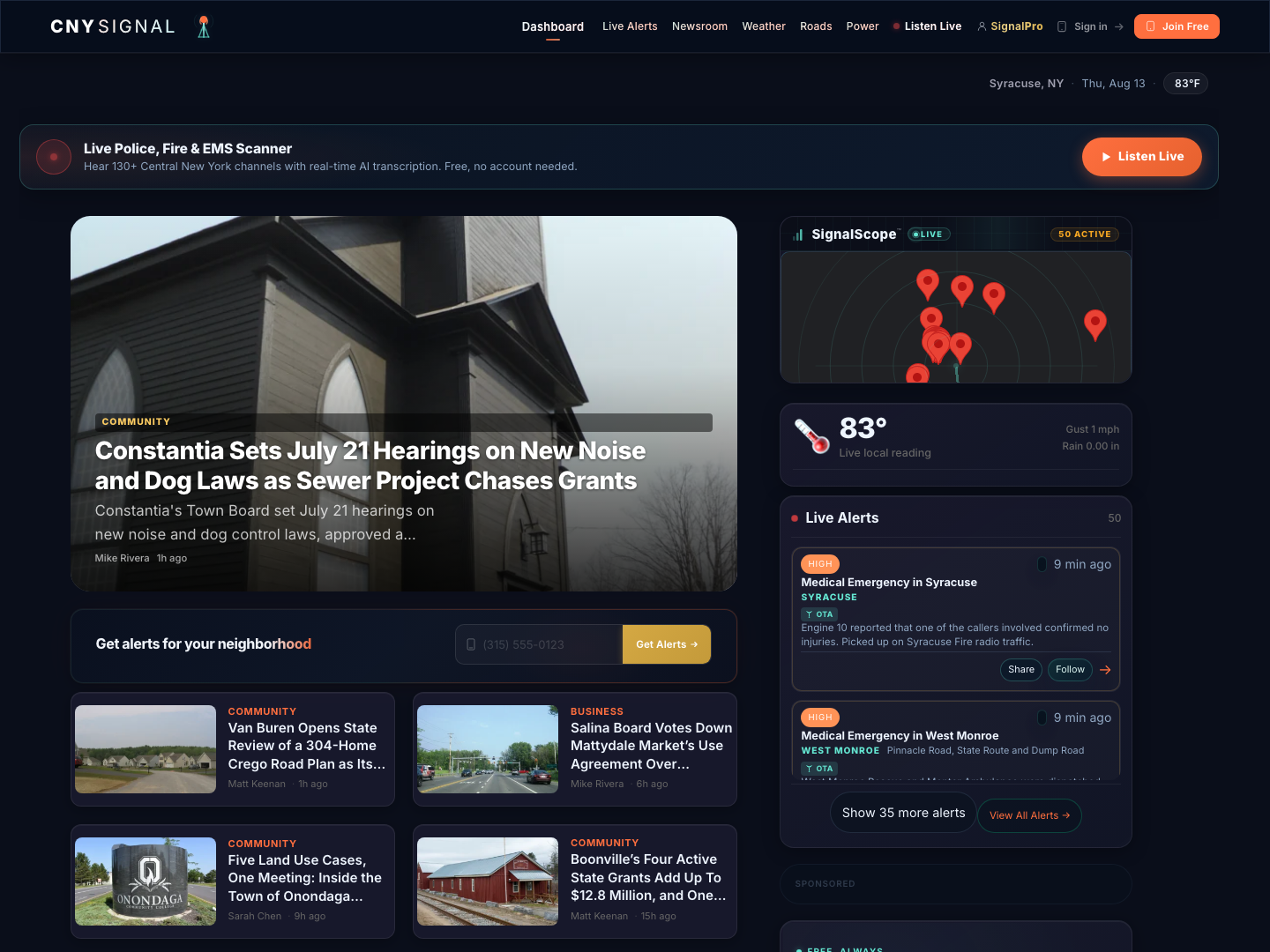
CNY Signal
A live public safety and local news dashboard for Central New York. It streams more than 130 Central New York scanner channels with real time transcription, turns what it hears into a live alert feed, plots incidents on a map, and carries local stories with a byline and a timestamp.
Why it belongs on this page: it is the hardest kind of system to operate rather than to build. Audio, transcription, alerts and the map all have to keep moving continuously, with nobody watching the server, at exactly the hours when something is happening.
- Address
- cnysignal.com
- Built by
- Express IT Solutions
- Hosting paid by
- Express IT Solutions
- Patched by
- Express IT Solutions
- On call at 3am
- Express IT Solutions
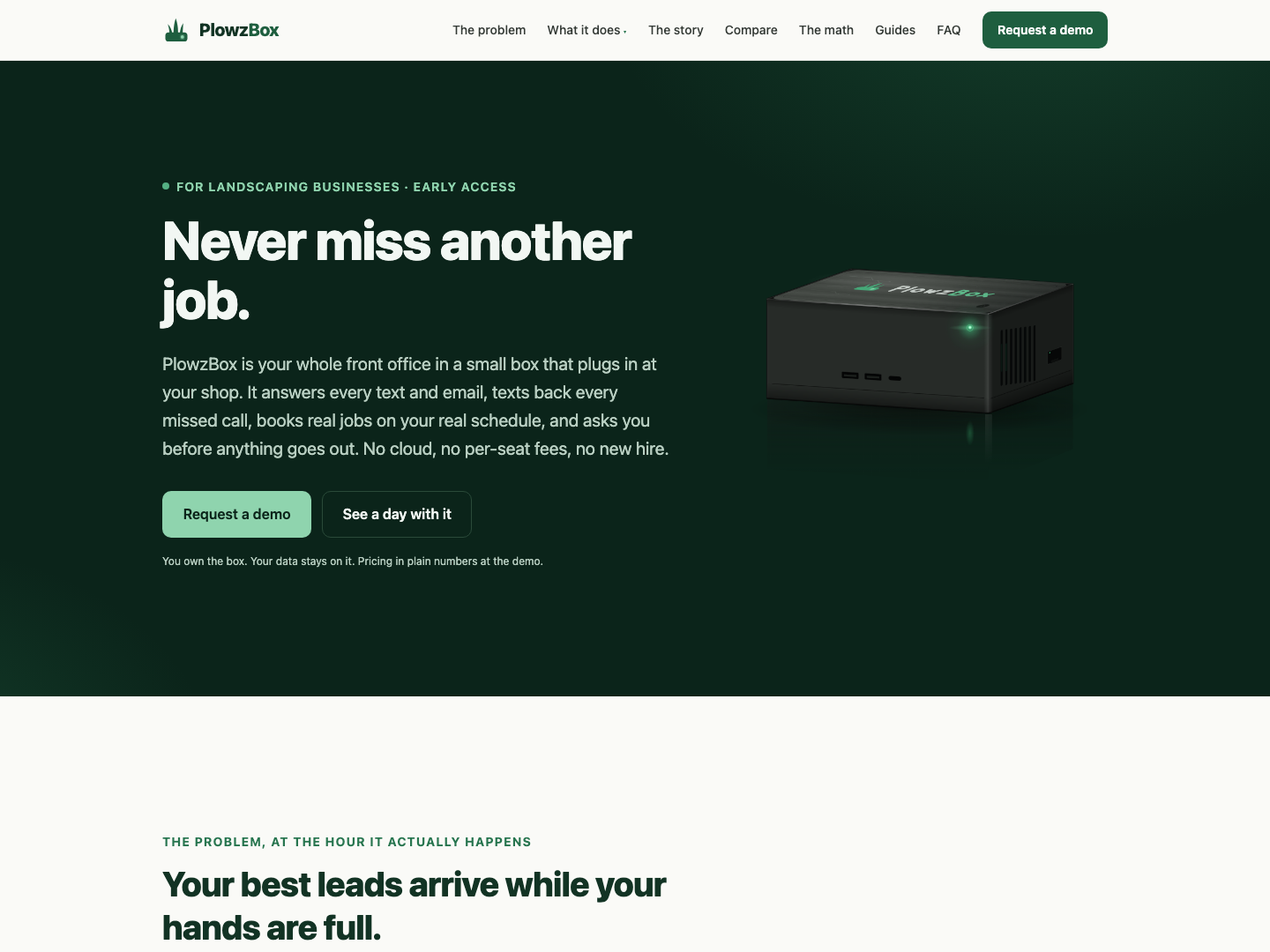
PlowzBox
A whole front office in a box that plugs in at the shop, built for landscaping and snow businesses. It answers every text and email, texts back every missed call, books jobs on the real schedule, and asks the owner before anything goes out.
Why it belongs on this page: it runs on premises rather than in the cloud, so the data stays on a box the customer owns. That is the same ownership position this page argues for, taken to its conclusion and then shipped as a product.
- Address
- plowzbox.com
- Built by
- Express IT Solutions
- Where it runs
- On premises, at the customer site
- Data held by
- The customer, on their own box
- Status
- Live now, in early access
Anybody can show you a case study. These are two addresses you can type in right now, and we are the ones on the hook when they are down.
How is this different from your web and app development page?
Same team, same office, different question. The web and app development page answers “can you build it”, and shows three builds you can open, including client work. This page answers the one that gets asked later and matters more: can you be trusted with the system the company runs on, and can we get our business out of it if we ever have to. If you are after a website or a first internal tool, start on that page instead.
The system the company runs on
Stay here if the question you are really asking is about the years after launch.
- A system that quotes, schedules, dispatches or invoices
- Somebody built it, then vanished, and you inherited it
- You want the ownership and exit terms in writing first
- You want to know who is still there in year four
Web and app development
That page answers whether we can build it, and proves it with builds you can open.
- A website, a rebuild or a marketing site
- Your first internal tool, rather than the system of record
- A customer facing app you want people to find
- You want to see finished client work first
What kind of systems do you actually build?
Four shapes, and almost every request is a version of one of them. The system the office currently runs on a shared spreadsheet and three group texts. The integration work that stops the same job being typed into four systems. The rescue, where somebody built it and then vanished. And one specific automated job inside a process a person is doing by hand. What we do not build is a platform for a business idea nobody has tested.
The system that replaces the spreadsheet
Intake, quoting, scheduling, dispatch, job tracking, inventory. The thing three people edit at once and nobody trusts by Thursday. This is the most common build we are asked for and the one with the clearest return, because the current process is already written down, it is just written down in a spreadsheet.
The integration work between what you already pay for
Accounting, CRM, phone system, calendar, forms and the field app. A job entered once should not be typed in three more times, and the reason it is usually comes down to two systems that were never introduced to each other. This is often cheaper than any new system and it is the first thing worth checking.
The rescue
Somebody built it, it works, and they have gone. No documentation, no repository you can reach, credentials nobody has, and a hosting account in a name you do not recognise. We take these on. The first piece of work is always an inventory of what actually exists, and it is worth doing whether or not we continue.
One automated job inside a manual process
Not a platform. One named job: reading an intake form and creating the record, chasing an unanswered quote, drafting the report somebody assembles by hand every Monday. This is where most of the automation projects we have delivered sit, and it is the cheapest useful thing on this page.
How does a build actually run?
Six steps, in this order. Most of the time on a build is not typing, it is deciding, so the sequence is arranged around getting decisions made early rather than around writing code fast.
- One short call, free and with no obligation. What the process is now, roughly how many people touch it, what it has to connect to, and what happens today when it goes wrong. We also ask who on your side is allowed to make decisions, because that answer moves the timeline more than anything technical.
- We say plainly whether it should be built at all. Sometimes the honest answer is that you should buy a product rather than build one, or that the right project is integrating what you already pay for. We say that on the first call rather than after you have spent money.
- A look at the work as it actually happens. Remotely, or in your building, watching the current process and sitting with the people who will use the thing. You can also start with a free site survey, which is the same look booked as its own visit.
- A scope and a real number, in writing. What is included, what is not, what we need from you, and what the running cost looks like after launch. Nothing starts until you agree to it.
- The accounts go in your name first, not last. The repository, the domain, the hosting account and the analytics are created in your company’s name before the build starts, so ownership is never something you have to ask for later.
- Handover in writing, then the years after. The handoff document lists what was built, what it runs on, what it connects to, and what is under support until when. If you later go elsewhere, that document goes with you.
How big is the team, and what does that mean for us?
We are a small local firm, and you should weigh that both ways rather than hearing it as modesty. What it costs you: no bench to throw at a deadline, so a big system is built in sequence rather than in parallel, and we will not pretend otherwise to win the job. What it buys you: the people who write the code are the people who answer the phone, the escalation path is short, and nobody hands your project to a team you never meet.
What it costs you
- No bench to throw at a deadline
- A big system is built in sequence rather than in parallel
- We will not pretend otherwise in order to win the job
- If a fixed date does not fit that, we say so on the first call
What it buys you
- The people who write the code are the people who answer the phone
- The escalation path runs to the engineers who built it, not an account manager
- Nobody hands your project to a team you never meet
- The same firm is still here, at the same address, in year four
Who owns the code, the data and the accounts?
You do, from day one rather than at the end. The code, the repository, the domain, the hosting account and the analytics go in your company’s name, not ours. We hold the keys while we run it for you, and you can take them elsewhere without asking permission. Your data belongs to you in a format you can read and export without us. That is written into what you sign rather than left to trust, and you should insist on it from anybody.
What happens in year four, when whoever built it has moved on?
This is the real enterprise question and it is the one almost nobody asks until it is too late. Software rots: dependencies stop being maintained, a platform ends support, a certificate expires, the payment processor changes an API. Somebody has to be there for that, and the honest test of any firm quoting you is not what it shows you now, it is what it can show you that it has kept running for years. Ask us that question directly. We are unusually well placed to answer it.
What will you not take on?
Consumer apps and venture scale product bets, because we build business software. Native iPhone and Android store builds, because what we do properly is web software that works properly on a phone. Anything on a stack nobody here could support at two in the morning. Any project where nobody on your side is allowed to make decisions. And any timeline we would have to be optimistic about in order to win the work. We will say so on the first call.
Ten things to establish before anybody builds the system your company runs on
The web and app development page carries a checklist about hiring a builder. This one is deliberately different. Every item here is about the years after launch, which is where a line of business system actually costs or saves you money. Put all ten to every firm quoting you, including us.
- Ask for a system you can open, that they have run for more than two years. Not a screenshot, not a case study PDF, not a logo wall. A URL, and a straight answer to what they do when it breaks at six in the morning. This is the question most firms cannot answer, and it is the cheapest one to ask.
- Get a copy of the code into a repository in your own company’s name, on day one. Not escrow triggered by a bankruptcy clause you will never invoke. An account you own, that you can add somebody else to on a Tuesday afternoon without anybody’s permission.
- Ask for a data export you can actually read, and test it before launch. Not “we can export it if you need to”. A file, produced on request, in a format your accountant or your next developer can open. A system you cannot get your own data out of is a system that owns you.
- Find out whose name is on the hosting, the domain and the payment gateway. If any of them are in the builder’s name, you are renting your own business. Ask to see the account, not to be told about it.
- Ask what the monthly running cost is, before launch, in writing. Hosting, licences, third party services, and any per user fee the builder pays somebody else. It is a forever cost and it is almost never in the proposal.
- Get the patching answer for month seven. Who applies security updates, how often, and what it costs. Every system built with modern tooling has dependencies that will need updating within a year of launch, and “we will look at it” is not an answer.
- Name the single point of failure on their side, out loud. If one person knows how it works, that is your risk, not theirs. Ask who the second person is, and ask what happens if the first one is unavailable for a month.
- List every integration and who holds each credential. Every connection to your accounting, your phone system or your card processor is a key to something. Know which keys exist, who can revoke them, and how they get rotated when somebody leaves.
- Ask what a schema change costs you in downtime. Systems change. The useful question is whether adding a field or a new job type is an afternoon or an outage, and any firm that has actually operated software will have a real answer to it.
- Ask for the handoff document before you sign, not when you leave. What it contains, in what format, and how quickly it is produced. Ask to see one from another job with the names removed. Anybody confident in the work will show you.
If you would rather we went through this with you against a proposal you already have, that is a phone call and not a sales meeting: (315) 682-6372.
Do you work with businesses outside Syracuse?
Yes. Build work is largely remote anyway, and the parts that are not are the ones worth turning up for: watching the current process happen, sitting with the people who will use it, and being in the building on the day it goes live. We work on site across all of Upstate New York from our offices in Fayetteville and downtown Syracuse, and clients who run more than one office are covered at every location, including the ones we reach by air.
What does a system like this cost?
We do not publish a figure, because a number without your details is a guess and you would be right to distrust it. What moves it is how many screens there are, how many systems it has to talk to, whether anybody has written down what it should do, and whether it has to keep running afterwards. Ask every firm you talk to what their number covers after launch, because that is where the difference usually is. What we do publish is the managed side, on our managed IT pricing page.
A firm that runs its own software in production.
Most of what goes wrong with a software supplier is not technical. It is that the firm sold you a team you never met, staffed the job with whoever was free, and then lost the one person who understood it.
- One legal entity since 2005. Express Computer Service L.L.C., filed 13 May 2005, trading as Express IT Solutions. 21 years of the same company, the same owner and the same address, which is the whole point on a page about year four.
- Independently run, and the people who answer write the code. Our developers designed and built the software shown on this page. The escalation path is short.
- We operate what we built. plowzbox.com and cnysignal.com are live on the public internet, and we pay their hosting, patch them and answer for them. Open either one now.
- We are also the IT firm. Hosting, DNS, SSL, email deliverability, monitoring and cloud, Microsoft 365 and backup are ordinary work here rather than something subcontracted, which is the actual difference between an IT firm building your system and an agency building it. That is the same team that does our business IT services and managed IT.
- A real address you can visit. 511 East Genesee St, Suite 8A, Fayetteville, NY 13066, a short drive from Syracuse, Manlius, Dewitt and Chittenango.
- Rated 4.9 from 154 reviews. You can read them here rather than take the number on trust.
What companies ask before they commit to a build
What counts as enterprise software?
Not size, consequence. An enterprise system is the one your company cannot work around for a day: quoting, scheduling, dispatch, job tracking, invoicing, or whatever your version of those is. A twelve person contractor whose entire schedule lives in one system is carrying more risk than a two hundred person firm with a spreadsheet nobody depends on. If losing it for an afternoon would stop the work, it is the kind of system this page is about, whatever the headcount is.
Can you show us software you built that is running right now?
Yes, and the part that matters is that we still run it. We designed, built and operate plowzbox.com and cnysignal.com, both live on the public internet and both openable in another tab without asking us for anything. We pay their hosting, we patch them, and we are the ones woken up when they are down. A firm that has only ever handed software over has not learned what the fourth year of running something teaches, and that is the year your system will be in.
How big is your team?
We are a small local firm and you should weigh that both ways. What it costs you is that there is no bench to throw at a deadline, so a large system gets built in sequence rather than in parallel, and we will say so rather than pretend otherwise to win the work. What it buys you is that the people writing the code are the people who answer the phone, and the escalation path runs to the engineers who built it rather than an account manager.
Who owns the code and the data when the project is done?
You do, from day one rather than at the end. The code, the repository, the domain, the hosting account and the analytics go in your company’s name and not ours. We hold the keys while we run it for you and you can take them elsewhere without asking permission. Your data belongs to you in a format you can read and export without us. That is written into the agreement rather than left to trust, and you should insist on it from anybody who quotes you.
What happens if we want to move to another firm later?
You take the repository, the accounts, the documentation and a data export, and you go. None of those need to be requested from us in a bad moment because they are already in your name. The handoff document lists what was built, what it runs on, what it connects to and what is under support until when. Ask to see an example from another job with the names removed before you sign, because anybody confident in the work will show you one.
Do you build ERP, CRM and similar systems?
Sometimes the honest answer is that you should buy one rather than build one, and we will say so on the first call. Established products exist for accounting, payroll and general purpose CRM, and building your own version of those rarely pays back. What is genuinely worth building is the part of your business no product fits: the way you quote, schedule, dispatch and track work. Very often the right project is integrating the products you already pay for rather than replacing them.
Can you take over software somebody else built and abandoned?
Yes, and it is a normal request. The first piece of work is always an inventory of what actually exists: where the code is, who holds the accounts, what it runs on, what it connects to and what is no longer supported. That inventory is worth having whether or not we carry on, because it is the thing you will need for any conversation with anybody. Bring whatever you have, including nothing, and we will start from there.
Will you build us a mobile app for the app stores?
Not native iPhone and Android store builds, and we will tell you that before you pay us anything. What we build is web software that works properly on a phone, which for a line of business system is usually what was actually wanted: the crew opens a link, it works on whatever device they have, and nothing waits on an app store review to ship a fix. If you genuinely need a store presence, we will say so and point you at who does that.
How long does a build take?
A straightforward system is measured in weeks. One that has to talk to systems you already run is measured in months, and most of that time is not typing, it is deciding. The single biggest cause of a slow project is nobody on your side being allowed to make a decision, so we will ask who that person is on the first call. If a date is fixed, say so early, because it changes what is worth building first.
What does a build cost?
We do not publish a figure, because a number without your details is a guess and you would be right to distrust it. What moves it is how many screens there are, how many systems it has to talk to, whether anybody has written down what it should do, and whether it has to keep running afterwards. We scope it on one short call and give you a real number in writing. Ask every firm you talk to what their figure covers after launch.
DESCRIBE THE SYSTEM
What would stop working tomorrow if it went away?
The process, roughly how many people touch it, what it has to connect to, and what happens today when it goes wrong. That is enough for us to tell you what it takes and what it does not need.
- It goes to our office in Fayetteville, not a call centre.
- You own the code and the accounts from day one, in writing.
- If buying beats building, we will tell you that instead.
If a system is down right now, call instead
A form waits for somebody to read it. A system nobody can quote or dispatch from does not wait, so pick up the phone. That includes software somebody else built and left behind.
The form is the better route for a project you are planning, a proposal you want a second opinion on, or anything with a date rather than a deadline of now.
(315) 682-6372Open what we built, then tell us what you need.
plowzbox.com and cnysignal.com are live right now. Look at them, then give us one short call, free and with no obligation, and we will tell you what your system would take, what it does not need, and whether buying something beats building it.
Free first call. We will tell you straight if the answer is to fix what you have instead of building something new.
Express IT Solutions · Computer service in Central New York since 2005 · Last updated August 16, 2026