
Business IT services for Syracuse and Upstate New York.
This is the page for work with a beginning and an end. A new office network, a move to Microsoft 365, a server that has to be replaced, a security clean up after something went wrong, or a second opinion before you sign a contract with somebody else. We have run a computer service business in Central New York since 2005, now from offices in Fayetteville and downtown Syracuse, and a person answers at (315) 682-6372.
Want the whole lot handled every month instead? That is managed IT, and it is a different page.
Business IT services are the pieces of work a company needs done once, or now, or every so often: networks, cabling, cloud migrations, servers, security work, backups, phones and automation. Express IT Solutions has run a computer service business in Central New York since 2005, from 511 East Genesee St in Fayetteville, and works on site across Upstate New York. Managed IT is the separate flat monthly plan. Call (315) 682-6372.
What counts as business IT services, and what is managed IT instead?
Both come from the same team, the same office and the same phone number. The difference is how the work is bought. Managed IT is an ongoing agreement with a flat monthly figure that covers your whole estate. Business IT services is everything else: defined jobs, urgent jobs, and help alongside an IT person you already employ.
| How it is bought | What it covers | Who it usually suits |
|---|---|---|
| Project work | A scope, a start, an end, and a figure agreed before it begins | A move, a migration, a rebuild, a new site |
| Ad hoc and hourly | Called in when something breaks or something is needed | Firms with light needs, or with cover already |
| Co-managed | We take the parts your own IT person cannot cover alone | One internal person carrying too much |
| Managed IT plan | Everything, every month, one flat bill | Firms that want one number and no surprises |
No figures are printed on this page on purpose, because a project price depends on what the project is. What is published sits on our managed IT pricing page, and the packages themselves on MSP business packages. For project and hourly work, you get the figure in writing before anything is ordered or started.
What do you actually do for businesses?
Nine kinds of job, all of which we do as standalone work and all of which are also inside a managed plan. If yours is not on this list, it is still worth the phone call, because most of what we get asked for is a version of one of these.
Networks, switching and cabling
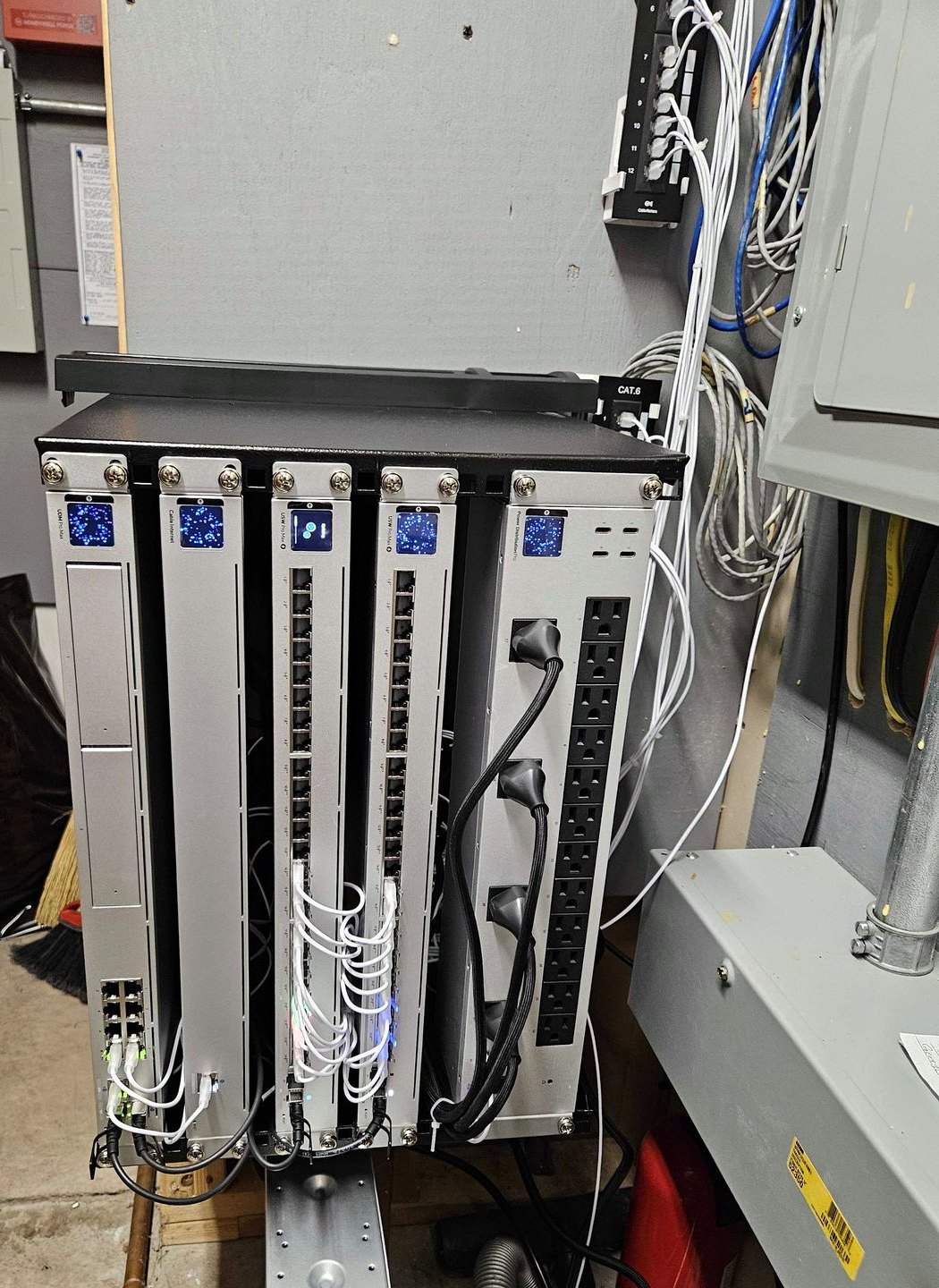
Wired and wireless networks for offices, warehouses and multi floor buildings. Racks, switches, access points, structured cabling and the labelling that makes the next visit shorter.
Microsoft 365 and cloud moves
Email, files and identity moved without losing history or breaking logins. Tenant setup, mailbox and file migration, sharing rules, and the licence tidy up that usually follows a move.
Cybersecurity work
Multi factor rollout, endpoint protection, email filtering, firewall and access review, and the clean up after an incident. Standalone assessments too, if you want to know where you stand before you commit to anything.
Backup and disaster recovery
Backups that are tested rather than assumed, for servers, workstations and cloud data. We will also tell you plainly what your current backup would and would not get back, which is a short and useful conversation.
Servers, storage and hardware
Specifying, supplying and installing servers, NAS storage, workstations and laptops. Old kit retired properly, data moved across, and the licence and warranty position written down instead of guessed at.
AI and automation projects
Software that does a job somebody is doing by hand: intake, quoting, scheduling, follow up, reporting. We have delivered AI and automation projects across Central New York, and the first conversation is about whether yours is worth building at all.
Phone systems and VoIP
Business phones that survive an internet outage plan, number porting handled rather than hoped for, handsets configured, and call routing set up the way the office actually answers calls.
Office moves and new sites
A move is the job that goes wrong most often, because everything happens at once on a weekend. We survey the new space first, sequence the internet, cabling, kit and phones, and are there on the day it has to work.
IT audits and second opinions
Somebody has quoted you for something and you want to know if it is right. We will read it, tell you what we would do differently, and say so plainly if the answer is that the quote is fine and you should sign it.
How does a project actually run?
Six steps, in this order, every time. The point of writing them down is that you can tell where a job has gone off the rails, on ours or on anybody else’s.
- A conversation, free and with no obligation. What you are trying to achieve, what is in the way, and what has already been tried. Some of this gets answered on the call, and where it does, we say so.
- A look at what you actually have. Remotely, or on site, or both. You can also start with a free site survey, which is the same look booked as its own visit.
- A scope in writing. What is included, what is not, what we need from you, and what happens if something is found once the walls are open.
- A figure, before anything is ordered. Hardware, licences and labour separated out, so you can see what is a one off purchase and what is our time.
- The work, with a date. Out of hours where it has to be. Multi site work is planned with you in advance, including travel, and we cover clients at every one of their locations.
- Handover, in writing. What was installed, what the passwords are, what is under warranty and until when. If you later go elsewhere, that document goes with you.
Eight things to get in writing before you sign off an IT project
None of these are unreasonable to ask for and none of them cost the provider anything. A firm that will not put them in writing is telling you something useful, and it costs you nothing to find that out before the work rather than after it.
- The scope, written as what is excluded. Every proposal lists what is included. The useful half is the list of what is not, because that is where the second invoice comes from.
- Hardware, licences and labour priced separately. One blended figure hides which part is a purchase you keep and which part is somebody’s time.
- Who owns the licences and the domain. They should be in your company’s name and your tenant, not the provider’s. Ask to see where they are registered.
- The administrator credentials, and where they live. You should be able to get into your own systems without ringing anybody. Ask how you get them on day one, not on the way out.
- What happens if something is found mid job. Old cabling, a dead switch, a licence that will not transfer. Agree in advance how a change is priced and who signs it off.
- The date, and what happens if it slips. Especially for a move or a cutover, where the whole point is that Monday morning works.
- What the handover document contains. Diagrams, addresses, passwords, warranty end dates. Ask to see an example from another job with the names removed.
- The exit terms, before you need them. Notice period, what you get back, in what format, and at what cost. The best time to read this is when nobody is annoyed.
Take this list to whoever you are talking to. If you would rather we went through it with you against a quote you already have, that is a phone call, not a sales meeting: (315) 682-6372.
Do we have to sign a monthly contract to get help?
No. Plenty of the businesses we work with have never been on a plan and call us when they need something. A monthly agreement exists because some firms want a predictable bill and everything covered, not because it is the only way in. If a plan would genuinely cost you less than the way you buy now, we will say so, and if it would not, we will say that too. The managed IT pricing page sets out how that side is priced.
Can you work alongside the IT person we already have?
Yes, and it is more common than replacing anybody. One internal person can carry a helpdesk or a project, rarely both, and almost never the specialist pieces on top. Co-managed work means we take defined parts, usually the after hours cover, the security tooling, the server and network layer, or a project that would otherwise stall. Your person keeps the relationship with the staff and keeps their job, which is usually the unasked question in the room.
| Where the line usually falls | Your IT person | Us |
|---|---|---|
| Day to day helpdesk | Keeps it | Overflow and cover |
| Servers, network and firewall | Shares it | Owns the build and changes |
| Security tooling and patching | Visibility | Runs and reports on it |
| Projects and migrations | Involved | Delivers to a scope |
| Out of hours and holidays | Off duty | Cover, agreed in advance |
Do you come to us, and how far do you travel?
We work on site across all of Upstate New York, from our offices at 511 East Genesee St in Fayetteville and 120 Madison St, Suite 1000 in downtown Syracuse. Clients who run more than one office are covered at every location, and where a location is far enough that driving does not make sense, that includes travel by air. Travel is planned and agreed with you in advance rather than appearing on an invoice afterwards. Express IT Solutions keeps no offices outside New York State. The service areas page maps the coverage town by town.
What does business IT work cost?
A project is priced from its scope, so the honest answer is that nobody can quote yours off a web page, including us. What is published is the managed side: managed IT pricing sets out how the per seat figure works and what moves it, and MSP business packages shows what sits in each package. For project and hourly work you get the figure in writing before anything is ordered, and nothing proceeds until you agree to it.
Technology Partners We Trust
We partner with industry-leading technology vendors to deliver the best solutions for your business.
Over 21 years, one company, one address.
Most of what goes wrong with an IT supplier is not technical. It is that the company changed hands, the person who knew your setup left, or the number now reaches somebody four states away who has to read your file before they can speak.
- One legal entity since 2005. Express Computer Service L.L.C., filed 13 May 2005, trading as Express IT Solutions. Not a franchise, not a rollup, not a brand licensed from somewhere else.
- Independently run. Express IT Solutions is owned and run from Fayetteville, and our engineers are reachable. If a job goes wrong, the escalation path is short.
- A real address you can visit. 511 East Genesee St, Suite 8A, Fayetteville, NY 13066, a short drive from Syracuse, Manlius, Dewitt and Chittenango.
- On site across Upstate New York, multi site included. Every location of a multi site client is covered on the same standard, including locations reached by air.
- Rated 4.9 from 154 reviews. You can read them here rather than take the number on trust.
What businesses ask before they hand over a project
What is the difference between business IT services and managed IT?
Managed IT is an ongoing agreement: we look after your whole estate, month after month, for a flat monthly figure, and the helpdesk, monitoring, patching and backups are all inside it. Business IT services is everything bought a different way. A project with a scope and an end date, an hourly job when something breaks, or work alongside an IT person you already employ. Same team, same office, same phone number, bought differently.
Do we have to be on a monthly plan to get help?
No. Plenty of the businesses we work with have never been on a plan and call us when they need something done. A monthly agreement exists because some firms want a predictable bill and everything covered, not because it is the only way to get help. If a plan would genuinely cost you less than the way you buy now, we will say so, and if it would not, we will say that too.
Can you work alongside the IT person we already have?
Yes, and it is more common than replacing anybody. One internal person can carry a helpdesk or a project, rarely both. Co-managed work means we take defined parts: the after hours cover, the security tooling, the server and network layer, or a project that would otherwise stall. Your person keeps the relationship with the staff and keeps their job, which is usually the unasked question in the room.
How far do you travel, and can you cover more than one office?
We work on site across all of Upstate New York, from our offices at 511 East Genesee St in Fayetteville and 120 Madison St, Suite 1000 in downtown Syracuse. Clients who run more than one office are covered at every location on the same standard, and where a location is far enough that driving does not make sense, that includes travel by air. Travel is planned and agreed with you in advance. Express IT Solutions keeps no offices outside New York State.
Can you take over from our current IT provider?
Yes, and the part worth getting right is the handover rather than the first day. Before you give notice, ask the current provider for the administrator credentials, the licence and domain registrations in your company name, the network documentation and the backup configuration. If they will not hand those over, that is worth knowing while you are still a paying customer. We will tell you what to ask for, whether or not you end up moving to us.
Do you supply the hardware, or do we buy it ourselves?
Either. We specify, supply and install servers, storage, workstations, laptops, switches and access points, and we are equally happy to specify something you buy yourself. On a quote, hardware, licences and labour are separated out, so you can see which part is a purchase you keep and which part is our time, and you can take the hardware line elsewhere if you want to.
What does it cost to have a project done?
A project is priced from its scope, so nobody can quote yours off a web page, including us. What is published is the managed side, on our managed IT pricing page and the MSP business packages page. For project and hourly work you get the figure in writing before anything is ordered or started, with hardware, licences and labour separated, and nothing proceeds until you agree to it.
TELL US WHAT YOU NEED DONE
Describe the job in your own words.
What you are trying to achieve, roughly how many people and machines are involved, and any date it has to happen by. That is enough for us to tell you how we would approach it.
- It goes to our office in Fayetteville, not a call centre.
- You get a scope and a figure before anything is ordered.
- If it is not worth doing, we will tell you that too.
If something is down right now, call instead
A form waits for someone to read it. An outage does not wait for anything, so if your office is off the air, pick up the phone. That is faster and it costs you less of the day.
The form is the better route for a project, a quote to look over, or anything with a date on it rather than a deadline of now.
(315) 682-6372Tell us what the job is.
One phone call and you will know how we would approach it, roughly what shape the work takes, and whether it is a project, an afternoon, or something you should not spend money on at all.
Free first call. We will tell you straight if the answer is that it is not worth doing.
Express IT Solutions · Computer service in Central New York since 2005 · Last updated August 16, 2026