
Start with one AI agent. Prove it. Then widen.
You do not have to bet the business on AI to find out whether it works for you. We take one workflow that eats your team’s day, build an agent for it, and show you what it actually saved. If it does not earn its keep, we do not widen it. Local team, one number, (315) 682-6372.
Not sure where to start? Take the AI readiness assessment first.
An AI agent pilot is a small, fixed-scope project where one agent takes over a single workflow so you can judge the results before committing to anything bigger. Express IT Solutions picks the workflow with you, builds the agent on the tools you already run, sets the access and approval rules before it touches live work, then measures what it saved. If it does not earn its keep, we do not widen it. On site across all of Upstate New York from one office in Fayetteville, and at the other locations multi site clients run, including the ones we fly to. Local since 2005. Call (315) 682-6372. The full town by town list is on the service areas page.
The cheapest way to find out if AI is worth it.
An assessment tells you which workflow to automate. A pilot proves the agent on it. Most AI projects go wrong by starting too big, and one workflow, done properly, tells you more than a six-month plan ever will. Gartner predicts more than 40 percent of agentic AI projects will be canceled by the end of 2027, citing unclear business value, rising cost and weak risk controls. A pilot is built to test all three before you commit to any of them.
Source: Gartner, Gartner Predicts Over 40% of Agentic AI Projects Will Be Canceled by End of 2027, press release, 25 June 2025, gartner.com. An industry forecast, not an Express IT Solutions result.
Fixed scope
One workflow, agreed in writing before we start. You know exactly what is being built and where it stops. No open-ended discovery bill.
Real numbers, not a demo
We measure the workflow before the agent touches it and again after. You get the actual difference on your own work, not a slide about someone else’s.
You keep what you learn
The scope document, the access rules, and the measurements are yours. If you decide to stop, you stop, and you still know more than when you started.
The best first agent is the most boring one.
Not the flashiest idea. The one your team does the same way forty times a week, that nobody enjoys, and that goes wrong when somebody is rushing. That is where an agent earns its keep fastest and where a mistake costs least.
- It repeats. The same shape of task, many times a week, with a clear start and finish.
- It is describable. If someone can train a new hire to do it, we can scope an agent for it.
- The stakes are survivable. A wrong answer is caught and corrected, not filed with the state.
- It touches systems we can reach. Email, your CRM, your help desk, the apps your business runs on.
For a lot of Central New York businesses the most boring repeating job is the inbound request pile at the front desk, which is exactly what AI front desk agents are built for.
Five steps, and you can stop after any of them.
This is the sequence we use. Nothing happens to live work until step four is signed off.
We sit down and map one workflow: the inputs, the systems it touches, and exactly where a person stays in the loop.
We build the agent to fit your stack, with hard limits on what it can and cannot do on its own.
We wire it into the tools you already run. Email, CRM, help desk, the apps your business actually lives in.
Access, data handling, and approvals are set to your privacy and compliance rules before it touches any live work.
We compare the workflow before and after, tell you straight what changed, and only then talk about widening it.
How big should a first AI agent pilot be?
One workflow, for almost everybody. Most businesses should start at Single Workflow, and we will say so on the call even if you came in asking for more. The three scopes below are sizes, not packages.
- One workflow scoped and mapped
- Agent built on your existing tools
- Access and approval rules set
- Before and after measurement
- Handover and a written scope doc
- Everything in Single Workflow
- A second agent on a related task
- Shared access rules across both
- Combined reporting on time saved
- A short plan for what to automate next
- Everything in Two Workflows
- Several agents across one department
- Staff training and handover sessions
- Ongoing monitoring and tuning
- A roadmap for the next department
These are starting points, not fixed packages. Which one fits depends on how many systems the agent has to reach and how strict your approval and compliance rules are, which is also what drives AI agent cost up or down. We work that out with you on a free, no obligation call and agree the exact scope in writing before any work starts.
A pilot, a full build, or doing it yourself
Three honest ways to get an AI agent running. Here is where each one actually fits.
| How it works | Do it yourself | Pilot with us | Full build up front |
|---|---|---|---|
| Who it suits | Teams with in-house technical time to spare | Businesses testing whether AI is worth it | Teams who already ran a pilot and know the answer |
| What you commit up front | Your own staff hours, open ended | One fixed-scope workflow | A full project budget and timeline |
| Security set up before go-live | Down to you | Built in | Built in |
| Measured against how it ran before | Rarely, in practice | Always | Usually, at project close |
| Someone to call when it misbehaves | Whoever built it, if they are still there | Your local team | Your local team |
| Easiest to walk away from | Yes, but you have spent the hours | Yes, that is the point | Harder, the budget is committed |
Scope and inclusions shown are a starting point and get tailored to your business. We confirm the exact scope in writing before you commit to anything.
What is an AI agent pilot?
An AI agent pilot is a small, fixed-scope project in which one AI agent takes over a single business workflow so the results can be measured before any wider rollout is committed to. It is deliberately narrow: one task, one set of systems, one agreed definition of what success looks like. The point is not to transform the business in one go. The point is to replace a guess about AI with a number from your own operation.
| The difference | A demo | A pilot |
|---|---|---|
| Whose data | Someone else’s, cleaned up | Yours, as messy as it really is |
| What it proves | That the software can work | Whether it works here |
| What you get after | A proposal | A working agent and a measurement |
| Who is accountable | Nobody yet | The team that built it |
How do you pick which workflow to automate first?
We look for a task that repeats often, has a clear beginning and end, can be described the way you would describe it to a new hire, and where a mistake gets caught rather than causing real damage. Then we check it touches systems we can reach safely. A high-volume, low-stakes, well-defined task gives you a clean read on whether an agent helps. A rare, high-stakes, fuzzy one tells you almost nothing and costs the most to get wrong.
| Good first candidate | Poor first candidate |
|---|---|
| Happens many times a week | Happens a few times a year |
| Has a clear finish line | Ends in a judgment call nobody can define |
| A wrong answer is caught in review | A wrong answer reaches a customer or a regulator |
| Lives in systems we can connect to | Lives in a system nobody can get an export from |
What happens if the pilot does not work?
Then we tell you, and we do not widen it. That is the entire reason to run a pilot at a small scope rather than committing a year of budget on a hunch. You keep the scope document, the access and approval rules we wrote, and the before and after measurement, so you know more about your own operation than when you started. We would rather lose the bigger project than talk you into automation that is not paying for itself.
- You keep the artifacts. The scope, the rules, and the measurements are yours to take anywhere.
- We say it plainly. If the honest read is that the workflow was not a good fit, that is what you will hear.
- No pressure to continue. A pilot that ends at the pilot is a valid outcome, not a failed sale.
- A real local number, (315) 682-6372, answered by the team that did the work.
What is included in an Express IT agent pilot
A starting checklist of what a pilot with us covers. We tailor the exact mix to your business and confirm it in writing before anything begins.
- A workflow mapping session where we walk the task end to end with the people who actually do it.
- A written scope document setting out what the agent will and will not do, agreed before we build.
- The agent itself, built to run on the tools you already use rather than a platform you have to adopt.
- Integration with your systems, email, CRM, help desk, and the line-of-business apps it needs to reach.
- Least-privilege access rules so the agent can only touch what its job actually requires.
- Human approval gates on anything sensitive or hard to undo, agreed with you up front.
- A before and after measurement of the workflow, so the result is a number rather than an impression.
- A handover session and a straight recommendation on whether to widen, adjust, or stop.
An agent sits on your data. So who builds it matters.
We are not an AI-only shop learning your network on the job. We are a Central New York managed IT and security firm that has kept local businesses running since 2005, now building agents on that same ground. We work on site across all of Upstate New York, and clients who run more than one office get the same team at every location, including the ones we fly to.
- We already know your systems. For a lot of our clients, the network the agent runs on is one we already run under our managed IT services in Syracuse and Central New York.
- Security is part of the build. Access rules and approvals get decided before go-live, not bolted on after.
- One accountable team. IT, security, and AI under one roof, so nobody gets to blame the other vendor.
- You can drive to us. 511 East Genesee St in Fayetteville, not a coworking desk and a contact form.
Three systems we designed, built and launched.
Before you let anyone build an agent on your systems, it is fair to ask what they have actually shipped. Two of these are products we build and operate. The third is a client site we built.
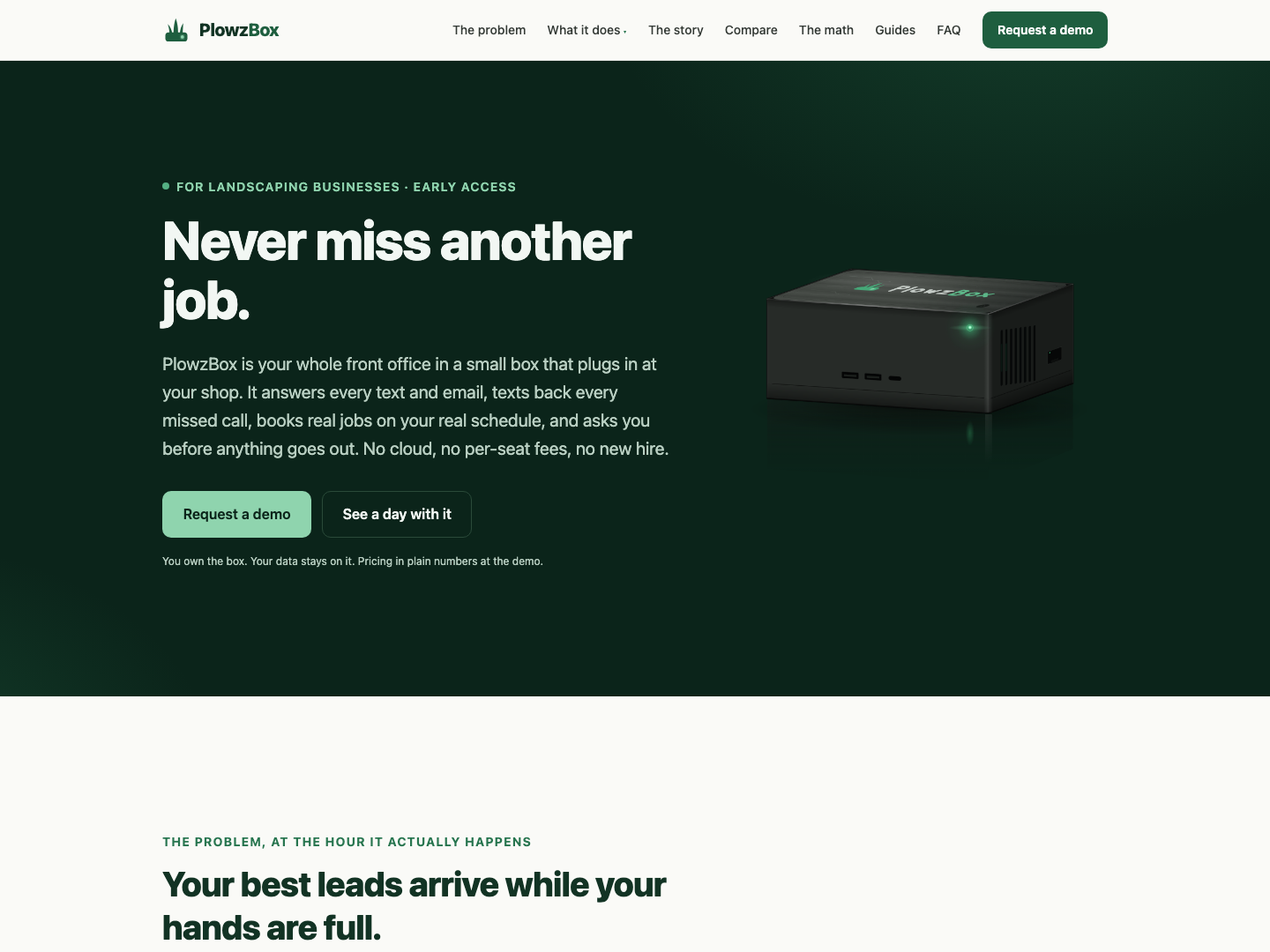
PlowzBox
A front office in a box for landscaping businesses. It answers texts and email, texts back missed calls, books jobs on the real schedule, and asks the owner before anything goes out. Now in early access.
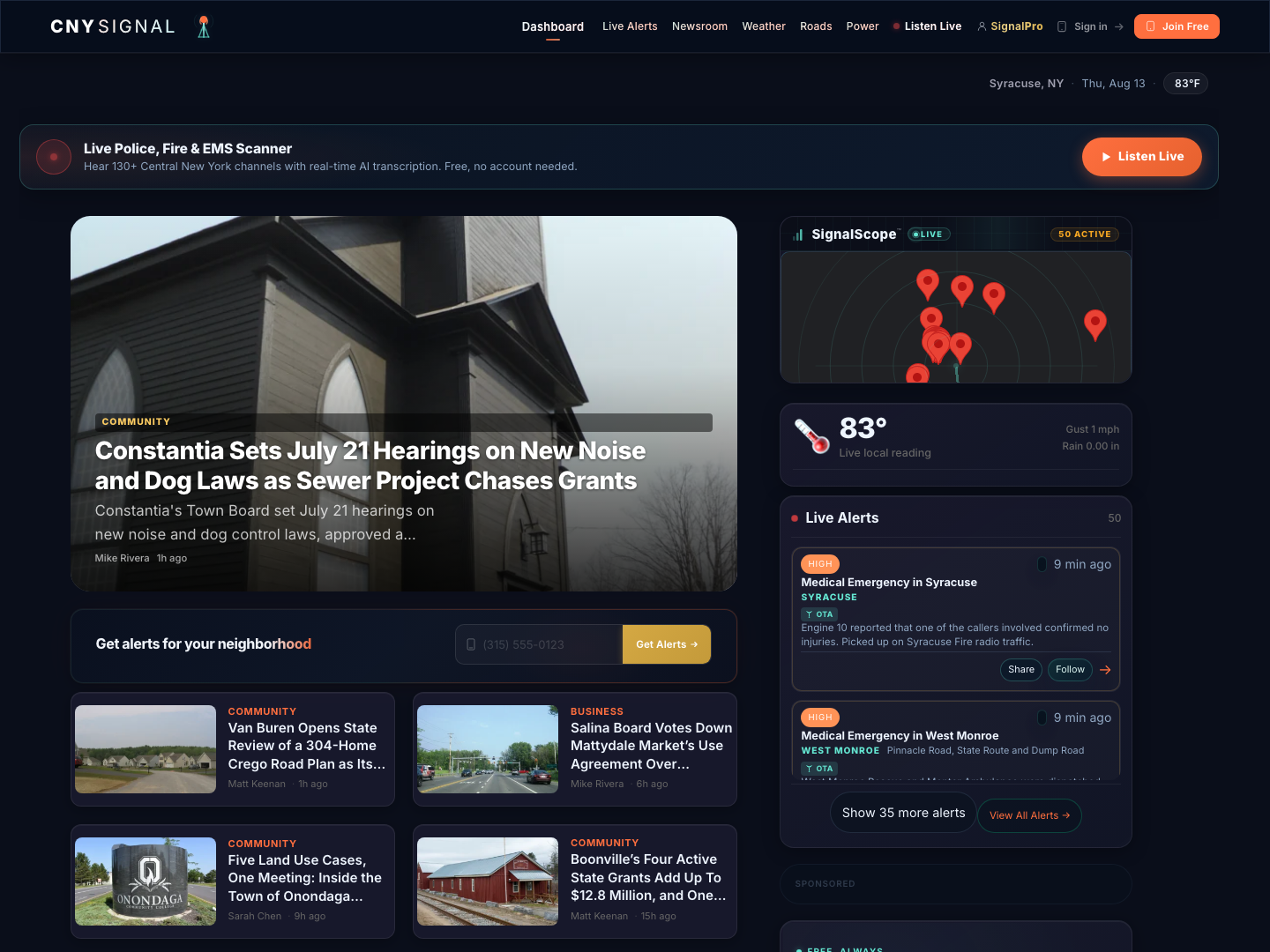
CNY Signal
A live Central New York dashboard: scanner audio from more than 130 local channels with real time AI transcription, alongside alerts, weather and roads. Free, no account needed.
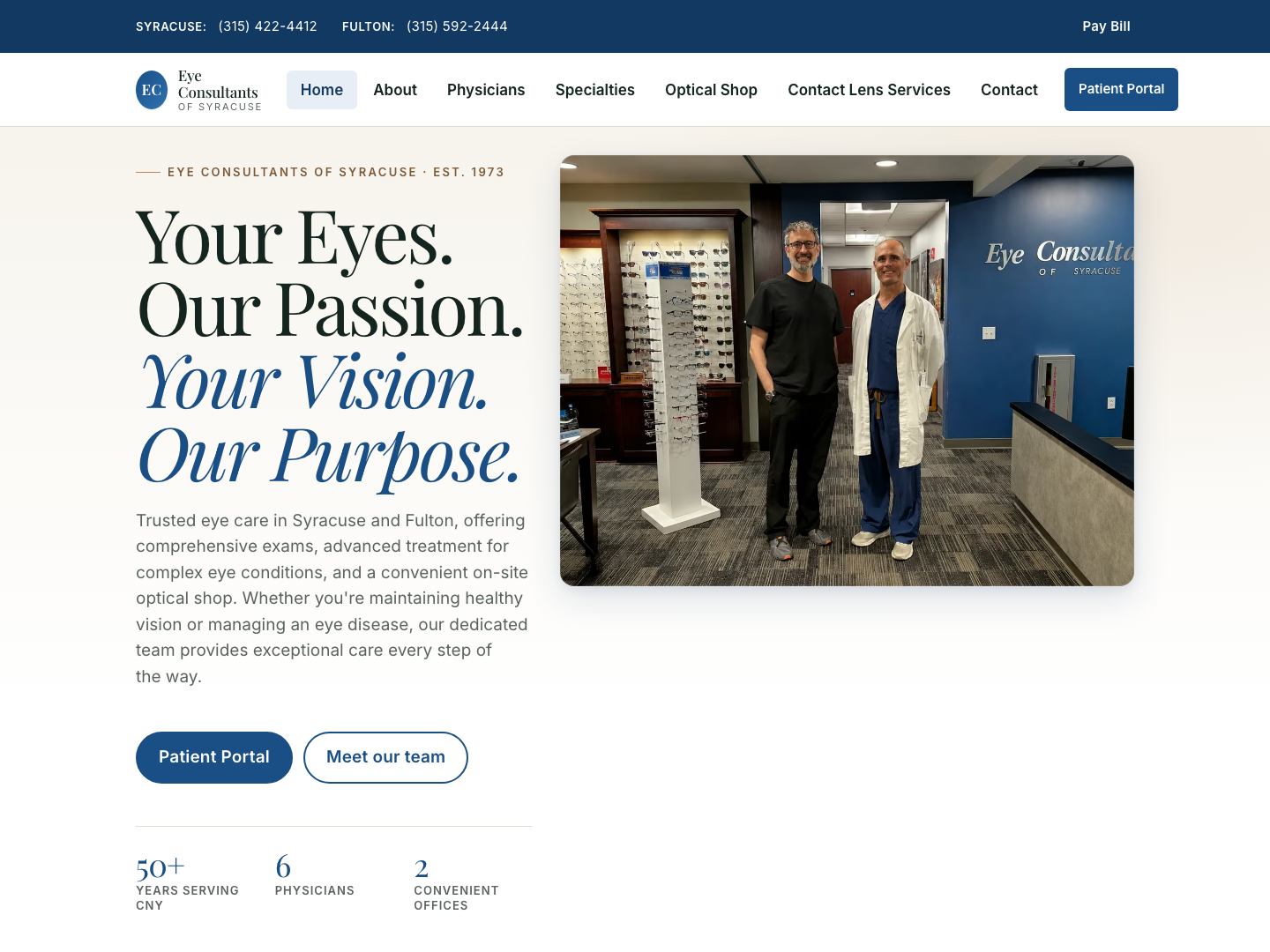
Eye Consultants of Syracuse
An ophthalmology practice site we built. Two offices, six board certified physicians, and a patient portal, for a practice serving Central New York since 1973.
These are our own products and our own client work, not pilot results for another business. They are here because the same Fayetteville team designs, builds and runs them.
What people ask before starting a pilot
What does an AI agent pilot cost?
It depends on how many systems the agent has to reach and how strict your approval and compliance rules are, so we quote it rather than guess on a webpage. It is a fixed scope, quoted in writing before any work starts, not an open-ended hourly project. Call us at (315) 682-6372 and we will scope it with you.
How long does a pilot take?
It depends almost entirely on how many systems the agent has to connect to and how quickly we can get access to them. A single workflow touching one or two familiar systems moves a lot faster than one that needs a new integration and a compliance review. We give you a realistic timeline as part of the written scope, before you commit.
Do we have to change the software we use?
No. We build the agent to fit the stack you already run rather than forcing a rip and replace. We review what you have first, and if something genuinely will not connect, we tell you that up front instead of quietly working around it.
Who is accountable if the agent gets something wrong?
We are, and you have a local number to call. That is the practical difference between a local team and a remote vendor. We also set approval gates so anything sensitive or hard to undo waits for a human yes, which means most mistakes get caught before they matter.
Will this replace someone on our team?
The goal is to remove repetitive work, not people. Agents typically take the high-volume routine tasks so your staff can spend time on the work that needs human judgment. We design them to assist your team and hand off to a person when something needs a real decision.
Can we start a pilot if you are not our IT provider?
Yes. A pilot does not require us to be your IT provider. It does mean we spend a little longer at the scoping stage getting to know your setup, and we will be honest if we find something that needs fixing before an agent should touch it.
TELL US THE WORKFLOW
Show us one workflow that eats your team’s time.
Pick the task you are sick of doing by hand. We will tell you straight how an agent would handle it, and whether it is worth doing at all.
- It goes to our office in Fayetteville, not a call centre.
- We will tell you straight if an agent is the wrong tool for the job.
- No revenue question, no budget question, no qualification hoops.
Or just call
That line reaches a person who knows the work. If you want an answer now instead of later today, calling is faster, and we would rather say that than pretend the form is.
The form is the better route if you would rather write it down than say it out loud, or you are somewhere you cannot take a call.
(315) 682-6372Show us one workflow that eats your team’s time.
Tell us the task you are sick of doing by hand. We will show you straight how an agent would handle it, what it connects to, and what a pilot would take. Free, no obligation, no hard sell.
Free workflow review. We will tell you straight if an agent is the wrong answer.
On site across all of Upstate New York, and the towns we are in constantly are Syracuse, Fayetteville, Baldwinsville, Cazenovia, Chittenango, Lafayette, Jamesville, Liverpool, Manlius, Minoa and Tully. Clients with more than one office are covered at every location they run, including the ones we fly to.
Express IT Solutions · AI agents for Central New York business · Last updated August 12, 2026