Web and app development in Syracuse and Central NY.
Most shops show you a mockup. We can show you software we designed, built, shipped and still run today, and you can open it in another tab right now. We are the local IT firm that also writes the code, based at 511 East Genesee St in Fayetteville since 2005, on site across all of Upstate New York and at the other locations our multi site clients run. Every town we cover is on the service areas page, with the distance from our door to each.
Or call (315) 682-6372 and describe it in five minutes.
Web and app development means designing, building and running the software a business actually uses: its website, its internal tools, and the connections between them. Express IT Solutions has done this since 2005 from 511 East Genesee St in Fayetteville, on site across all of Upstate New York and at every location its multi site clients run. Two of the three builds below are products of our own, plowzbox.com and cnysignal.com, and the third is client work for a Syracuse medical practice. All three are open right now. Call (315) 682-6372.
Three builds you can open in a tab right now.
Not client logos and not case study PDFs. Two are products with our name on the architecture, running in production with real users on them. The third is a client site we designed and built for a Syracuse medical practice. Open any of them and judge the work yourself.
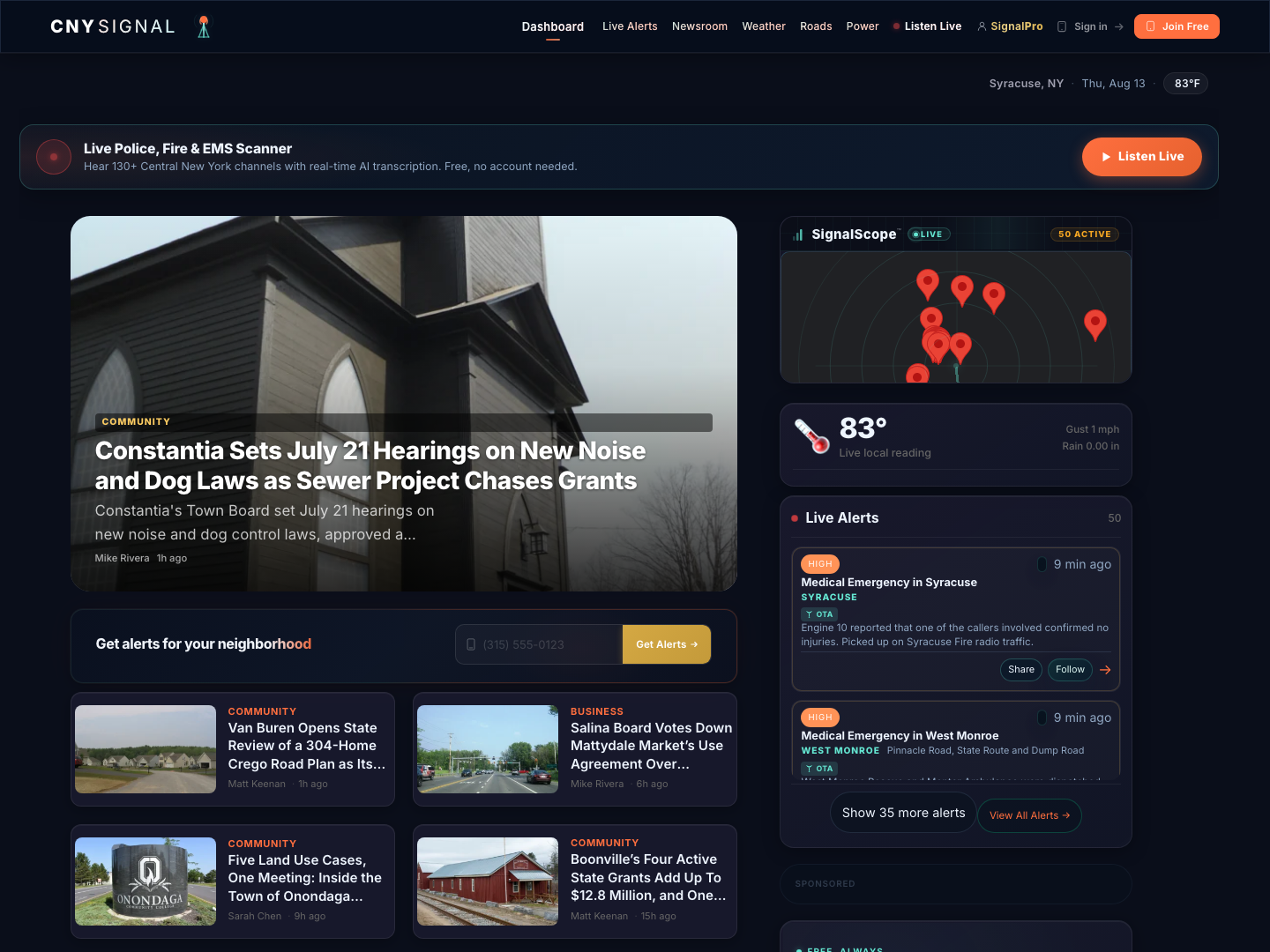
- The bar across the top is live police, fire and EMS scanner audio, transcribed as it is spoken. Free, no account needed.
- SignalScope, top right, plots incidents on a live map. It reads 50 active at the moment this screen was captured.
- Under it, the alert feed, each one tagged by town and by how long ago it came in.
- Everything else is the newsroom: local stories with a byline and a timestamp, published the same day.
Case 01
CNY Signal
A live public safety and local news dashboard for Central New York. Scanner audio, transcription, alerts, a live map, weather, roads and power, on one screen that has to stay up while things are happening.
- What it does
- Streams 130+ Central New York scanner channels with real-time AI transcription, then turns what it hears into a live alert feed
- The hard part
- Real time. Audio, transcription, alerts and the map all have to move together, continuously, with no one watching the server
- Our role
- Product design, build, hosting and day to day operation
- Status
- Live and running. Free to use, no account needed
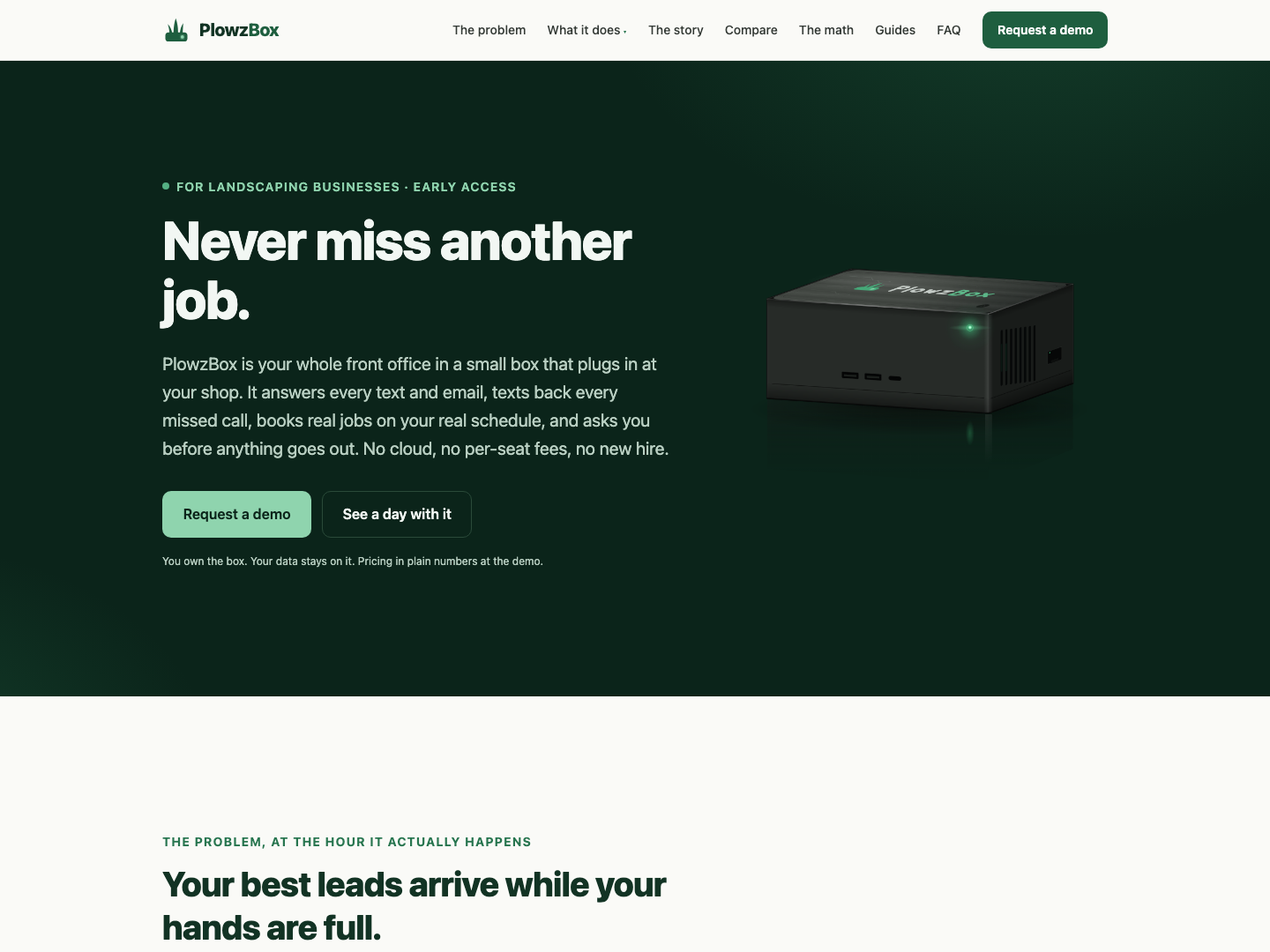
- The navigation is the argument: the problem, what it does, the story, compare, the math. A product that has to explain itself to a sceptical buyer.
- The hero states the job in four words, and the appliance itself sits beside it. Not an illustration of a box, the box.
- The line under the buttons is the promise the whole product is built around: you own the box, and your data stays on it.
Case 02
PlowzBox
A whole front office in a box that plugs in at the shop. Built for landscaping and snow businesses, where the best leads arrive at the exact hour nobody can pick up the phone.
- What it does
- Answers every text and email, texts back every missed call, books jobs on the real schedule, and asks the owner before anything goes out
- The hard part
- It runs on premises, not in the cloud, so the data stays on the box the customer owns
- Our role
- Hardware choice, product design, build, and the software that ships on it
- Status
- Live, currently in early access
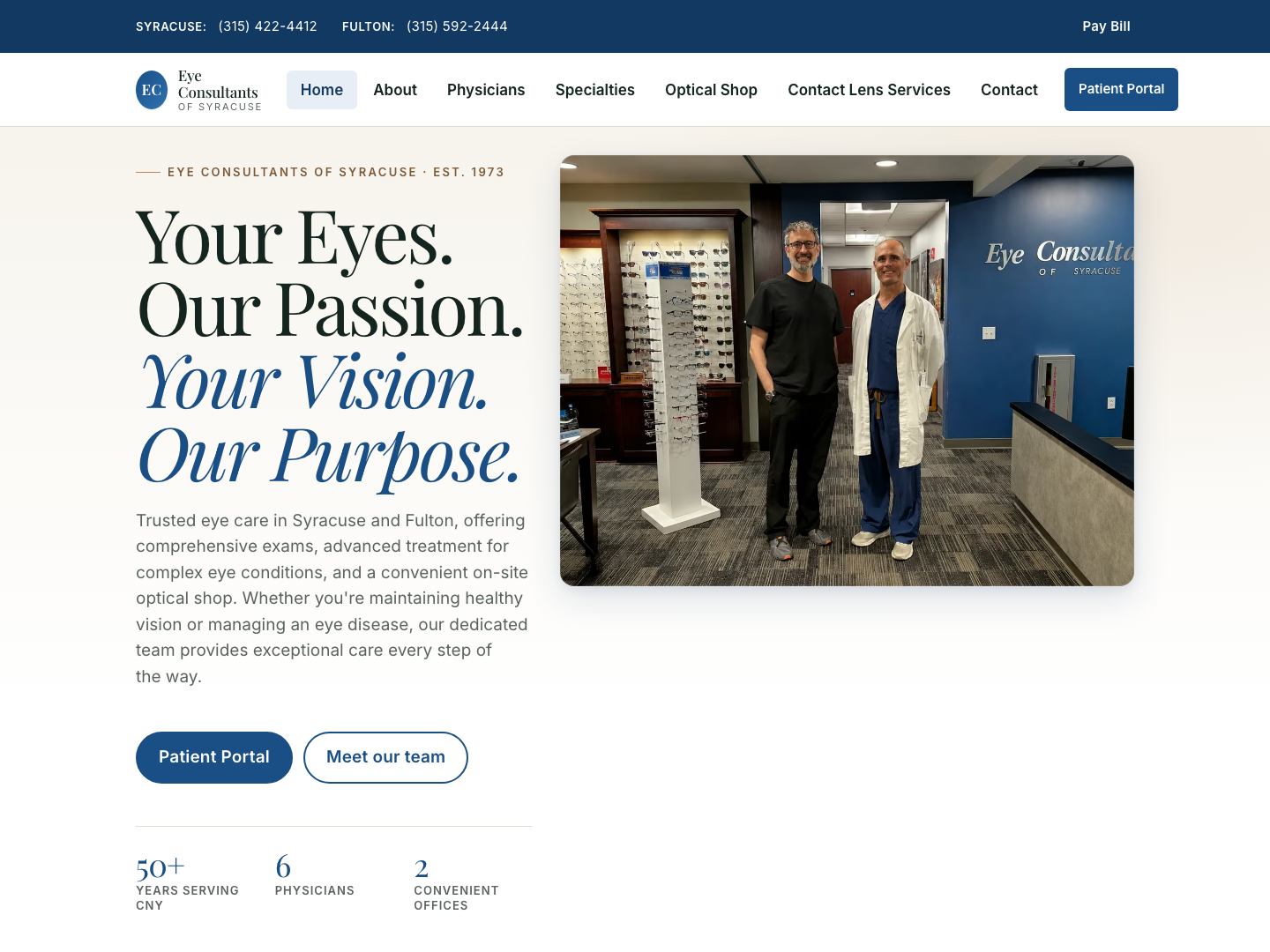
- Both office numbers sit above the navigation, one for Syracuse and one for Fulton, because the first thing most visitors want is the right number for the right office.
- Patient Portal is the only filled button in that bar. Everything else across the top is a plain link, including Pay Bill.
- The navigation is the practice, not a menu: About, Physicians, Specialties, Optical Shop, Contact Lens Services, Contact.
- The hero says where and what before anything else: eye care in Syracuse and Fulton, exams, treatment for complex conditions, and an on-site optical shop.
Case 03 · Client work
Eye Consultants of Syracuse
An eye care practice with two offices and six physicians. One public site that has to answer the two questions a patient arrives with: which doctor, and which office.
- What it is
- The public site for an ophthalmology practice: physicians, specialties, an optical shop, contact lens services, and the link to their patient portal
- The hard part
- A medical practice is a directory before it is a brochure. Two offices, two phone numbers and six physicians all have to be one tap away on a phone
- Our role
- Web and app development. We designed and built it. The practice runs it and holds its own accounts
- Status
- Live. This is client work, not an Express IT product, and nothing here is an endorsement by the practice
Anyone can show you a mockup. We can show you the login screen and hand you the URL.
Five kinds of work, and the honest version of each.
The two products above are the far end of what we do. Most of the work looks more like the third one, or smaller still: the site people find you on, and the tool that stops your office from living in a spreadsheet.
- A web form nobody reads
- Calls that go to voicemail
- A spreadsheet three people edit
- A vendor system that will not export
Designed in Fayetteville, hosted on infrastructure we manage, patched by the same people who answer the phone when it breaks.
- One place the work lives
- The office sees it as it happens
- Nothing waits for one person
- It still works a year later
Websites a local business can actually run
Built to load fast, be found, and be edited by someone who is not a developer. We handle the hosting, DNS, SSL, email routing and backups, because that is the part that quietly breaks.
Looks like: a service business site with real pages for real services, a booking link that works, and nobody chasing a renewal email at midnight.
Web apps and internal tools
Scheduling, dispatch, quoting, inventory, job tracking, customer portals. The thing your team currently runs on a shared spreadsheet, a whiteboard and three group texts.
Looks like: one screen the office and the crews both trust, instead of four versions of the truth.
Integrations between what you already pay for
Making your CRM, accounting, phone system, calendar and forms talk to each other, so a job entered once does not get typed in three more times.
Looks like: a booked job that reaches the calendar, the invoice and the crew without a human retyping it.
AI features that do one named job
Transcription, drafting, triage, texting back a missed call, reading a document so a person does not have to. We build the specific job, not a chatbot bolted to your home page.
Looks like: CNY Signal transcribing scanner traffic in real time, and PlowzBox answering a text at nine at night. Both above, both live.
Online stores and taking payments
A shop built on a platform we can still support in three years, with a card processor whose account is in your name, not ours. Most businesses here need a modest catalogue that stays accurate and a checkout that does not lose orders.
Looks like: your products in one place, card payments landing in your own merchant account, and stock numbers that match what is on the shelf.
Already a client? This is the same team that runs your managed IT, and the same team that builds AI agents and workflow automation.
Six steps, and you can stop after any of them.
No discovery phase that bills for a month before anything exists. You should be able to see something real early, and you should never be surprised by what arrives at the end.
- 01
A call where we mostly ask questions
Free, no obligation, usually under half an hour. What is the work, who touches it, what does it have to connect to, and what happens today when it goes wrong. Sometimes the honest answer at the end of this call is that you do not need us.
- 02
We write down what it has to do
Plain language, in writing, before anyone opens an editor. What is in, what is out, what it connects to, what done looks like. You approve that document. It is the thing we are both held to later.
- 03
You see something small, early
A working screen, not a slide of a screen. Early enough that changing your mind is cheap, because the point of showing it is that you will change your mind about something and we would rather find out now.
- 04
We build it where you can watch
A link you can open any day of the week to see where it is. Short check-ins rather than a long silence and a big reveal. If something is going to slip, you hear it from us before you notice it yourself.
- 05
We launch it, and we are on the hook
Hosting, DNS, SSL, email deliverability, backups, monitoring. Launch day is the part most builds get wrong, and it is the part we have been doing for other people’s systems since 2005.
- 06
We keep running it
Patching, updates, monitoring, and one number to call when something is wrong. This is optional and it is not a lock-in. It is simply the part almost nobody else offers, because it is the part that is actually work.
What we will not take on.
A short list, because saying yes to the wrong project is how both sides end up unhappy. If you are reading this and recognising your project on the right, we will still take the call and tell you who is a better fit.
Work we take on
- Sites and software for businesses that will still be using them in three years
- Internal tools where somebody can tell us exactly what the current process is
- Integrations between systems you already own and already pay for
- AI features with a named job and a clear way to tell whether it worked
- Rescues, where somebody else built it and then vanished
- Work we can host, patch and answer the phone about afterwards
Work we turn down
- A rebuild when the site you have needs three fixes, not a new site
- Consumer apps and venture scale product bets. We build business software
- Stacks nobody here could support at two in the morning
- Projects where nobody will own the decisions on your side
- AI features on a network that is not patched and backed up first
- Any timeline we would have to be optimistic about to win the job
- Native iPhone and Android builds for the app stores. We build web apps that work properly on a phone, and we will say so before you pay us.
The reason the list exists
We are a small local firm that still has to answer the phone in a year. A project we should not have taken costs us the thing we actually sell, which is being reachable and being right. We would rather turn the work down at the first call than explain it at the fourth invoice.
If we cannot support it after launch, we should not be the ones who build it.
A local IT firm, an agency, a freelancer, or doing it yourself?
All four of these are the right answer sometimes. This is the honest version, including the parts where we are not the best pick. Read the bottom row first.
| What matters | A local IT firm that builds | A web agency | A freelancer | Doing it yourself |
|---|---|---|---|---|
| Who you talk to | The people writing the code | An account manager, then a team you do not meet | The one person doing everything | You |
| Already knows your network, email and accounts | If we already run your IT | No, has to be told | No, has to be told | You do |
| Down at seven on a Tuesday morning | One local number, answered | A ticket queue, business hours | Depends entirely on the person | A support forum |
| Hosting, DNS, SSL and email handled | Included and run by us | Often resold or subcontracted | Usually handed back to you | Yours to hold |
| Still patched a year after launch | The same team that patches your servers | Only under a retainer | Rarely | Whenever someone remembers |
| Deep brand, campaign and content bench | No. We build and run it, we are not an ad agency | Yes, this is their strength | Varies by person | No |
| Cheapest possible day rate | No | No | Usually yes | Free, apart from your time |
| Best fit when | It has to keep running, and somebody local has to own that | The job is really a brand and campaign job | The scope is small, clear, and finishes | You are testing an idea and can throw it away |
Swipe the table sideways to see all four columns.
The questions people actually open with.
How much does a website or web app cost in Central New York?
We do not publish a figure, because a number without your details is a guess and you would be right to distrust it. What moves the price is how many screens there are, how many systems it has to talk to, whether anyone has written down what it should do, and whether it has to keep running afterwards. We scope it on one short call and give you a real number in writing.
Ask every firm you talk to what the number covers after launch. That is where the difference usually is.
A number without your details is a guess, and you would be right to distrust it.
How long does a build take, start to finish?
A straightforward business site is measured in weeks. An internal tool that has to talk to systems you already run is measured in months, and most of that time is not typing, it is deciding. The single biggest cause of a slow project is nobody on your side being allowed to make a decision. We will ask who that person is on the first call.
2005
Shipping and supporting systems for Central New York from an office in Fayetteville.
Who owns the code and the accounts when it is done?
You do. The code, the repository, the domain, the hosting account, the analytics, all of it in your name from day one, not ours. We will set them up for you and we will hold the keys while we run it, but the accounts are yours and you can take them somewhere else. That is written into what you sign, not left to trust.
The accounts go in your name on day one, not ours.
What happens after launch, when something breaks?
You call the same local number you would call about a server or a laptop, and a person answers. We monitor what we host, we patch it on the same schedule we patch the rest of your systems, and we tell you what happened in plain English afterwards. Support after launch is the whole reason an IT firm building your software is a different proposition from an agency building it.
Launch day is where most builds go wrong. It is the part we have done since 2005.
Can you add AI features to software we already have?
Often yes, and the honest first step is checking what the existing system will let us reach. If it has an API or a database we can read safely, we can usually add a specific capability without rebuilding anything. If it is a closed product with no way in, we will tell you that instead of quoting a workaround that would break at the next vendor update.
Before any AI work
Patched, backed up and monitored first. We will not bolt automation onto a network that is not secure, even when a client asks us to.
Do you do SEO and online marketing as well?
Every build leaves here with the technical groundwork search engines need: pages that load fast, a structure that can actually be crawled, correct titles and descriptions, a sitemap that resolves, and content you can edit yourself without calling us. Running ad campaigns and posting to social accounts month after month is a different discipline on a different budget. Tell us what you are actually trying to fix and we will say straight whether that part is us.
In every build
Fast pages, a crawlable structure, correct metadata, a working sitemap, and an editor a non developer can use.
Eight things to settle before you hire anyone to build software.
Including us. Take this list to every quote you get. The answers tell you more about what you are buying than any portfolio page will, and every one of them is cheaper to settle now than later.
- 01
Who owns the code and the repository
Get the answer in writing, on day one, before any work starts.
- 02
Whose name is on the accounts
Domain, hosting, analytics, app store, payment gateway. If they are in the builder’s name, you are renting your own business.
- 03
Where it will run, and who pays that bill
Hosting is a monthly cost forever. Find out what it is before launch, not on the first invoice after.
- 04
Who patches it after launch
Software rots. Ask who applies security updates in month seven, and what that costs.
- 05
What happens at seven on a Tuesday morning
Ask for the actual process when it is down. A phone number, a name, and a response time you can hold them to.
- 06
What done means, in writing
A document you both signed that says what is in and what is out. Almost every project argument traces back to not having one.
- 07
What it connects to, and who holds those credentials
Every integration is a key to something. Know which keys exist and who can revoke them.
- 08
What the handoff looks like if you leave
Ask before you sign, while the answer is still cheap to give. Anyone confident in the work will answer it plainly.
Before you call.
Can you show us something you built that is actually running?
Yes. We designed, built and operate plowzbox.com and cnysignal.com, and we designed and built eye-consultants.com for a Syracuse eye care practice. All three are live, all three are linked further up this page, and you can open any of them right now without asking us for anything. CNY Signal streams more than 130 Central New York scanner channels with real-time AI transcription. PlowzBox is an on premises appliance that answers texts and books jobs.
How much does a website or web app cost?
We do not publish a figure, because a number without your details is a guess. What moves it is how many screens there are, how many systems it has to talk to, whether anyone has written down what it should do, and whether it has to keep running afterwards. We scope it on one short call and give you a real number in writing. Call (315) 682-6372.
Do you build websites, or only custom software?
Both. Most of our work is ordinary and useful: a business website that loads fast and can be edited by someone who is not a developer, or an internal tool that replaces a shared spreadsheet. The two products we run are the far end of the same skill set, not a different service, and the practice site shown above is much closer to the everyday work.
Who owns the code and the accounts when the project is done?
You do. The code, the repository, the domain, the hosting account and the analytics are all in your name from day one. We hold the keys while we run it for you, and you can take them elsewhere. That is written into the agreement rather than left to trust.
Do you host and support what you build?
Yes, and it is the main reason to hire an IT firm for this instead of an agency. We handle hosting, DNS, SSL, email deliverability, backups, monitoring and patching, on the same schedule we use for the rest of your systems. It is optional, and it is not a lock-in.
Can you add AI features to a site or system we already have?
Often yes. The first step is checking what the existing system lets us reach safely. If there is an API or a database we can read, we can usually add one specific capability without rebuilding anything. If it is closed with no way in, we will tell you that rather than quote a workaround that breaks at the next vendor update.
We already have a developer. Can you work alongside them?
Yes, and it is a common arrangement. We often take the parts a solo developer does not want to own: hosting, security, backups, monitoring, and being reachable when something breaks at seven in the morning. We are not trying to replace someone who is doing good work for you.
Do you work with businesses outside Syracuse?
Yes. We are based in Fayetteville and we work on site across all of Upstate New York, and the towns we are in constantly are Syracuse, Manlius, Liverpool, Baldwinsville, Cazenovia, Chittenango, Minoa, Jamesville, Lafayette and Tully. Build work is largely remote anyway. If you run more than one office we cover every location you have, including the ones we fly to.
TELL US WHAT IT HAS TO DO
Tell us what it has to do.
Bring the spreadsheet, the half finished site, or just the problem. We will tell you what it takes, and what it does not need.
- It goes to our office in Fayetteville, not a call centre.
- We will tell you straight if there is a cheaper way to build it.
- No revenue question, no budget question, no qualification hoops.
Or just call
That line reaches a person who knows the work. If you want an answer now instead of later today, calling is faster, and we would rather say that than pretend the form is.
The form is the better route if you would rather write it down than say it out loud, or you are somewhere you cannot take a call.
(315) 682-6372Tell us what it has to do. We will tell you what it takes.
One short call, free, no obligation. Bring the spreadsheet, the half-finished site, or just the problem. If we are not the right people for it, we will say so and point you at who is.
We will give you a straight answer on the first call, including the answer that you should fix what you have instead of building something new.
Express IT Solutions · Building and running software for Central New York since 2005 · Last updated August 13, 2026