RAM is expensive because AI servers are taking roughly half of the world’s DRAM supply, and no forecaster sees that easing this year. TrendForce (Sept 30, 2026) projects conventional DRAM contract prices rising another 10 to 15 percent in the fourth quarter, and IDC (June 2, 2026) expects no meaningful relief before the end of 2027.
Short version for shoppers: computers cost more than a year ago, the increase lands hardest on configurations with more memory and storage, and the published outlook for 2027 is tighter supply, not looser. If your machine is failing or out of support, waiting is unlikely to pay. If it works, you can wait, but not because a price drop is scheduled.
Why RAM got so expensive
AI servers took the capacity. AI systems need high bandwidth memory (HBM) stacked beside the processor, plus ordinary server modules in bulk. TrendForce estimated (Aug 25, 2026) that HBM and server modules together would take 51 percent of DRAM bit supply in 2026, and HBM needs significantly more wafer input per bit than conventional DRAM (TrendForce, July 30, 2026), so a wafer sent to HBM yields fewer gigabytes than one sent to laptop memory.
Suppliers follow the margin. Samsung, SK hynix and Micron all reported record quarters between late July and the end of September 2026. Samsung (July 30, 2026) said server demand is projected to keep the market undersupplied even as PC and mobile demand moderates. Micron told investors (Sept 30, 2026) it expects supply and demand to be much tighter in fiscal 2027 and 2028 than in 2026, and that it has no line of sight to when the two return to balance.
Contract prices move first; your price moves later. Forecaster percentages are contract prices, what PC brands and module makers agree to pay each quarter. Retail prices, what a stick of RAM costs on a website, react faster and swing harder. A 10 to 15 percent contract increase raises the cost of building a laptop; brands pass it through as older inventory runs out, and the same lag means retail prices will not drop the week supply improves.
Is there an end in sight? What the forecasters actually say
Dated so you can check them; every line is a forecast or an estimate, not a fact about next year.
| Source and date | What it says |
|---|---|
| TrendForce, Sept 30, 2026 | Conventional DRAM contract prices projected up 10 to 15 percent in 4Q26, NAND flash up 15 to 20 percent, pace moderating. PC DRAM supply could decline in 2027 as capacity shifts to servers. |
| TrendForce, July 30, 2026 | New DRAM capacity will not ramp meaningfully until the second half of 2027, with substantial output in 2028. NAND flash (SSDs) projected to loosen in the second half of 2027. |
| IDC, June 2, 2026 | PC shipments forecast down 11.3 percent in 2026, with the fourth quarter down about 20 percent year over year. No meaningful relief before the end of 2027; pricing unlikely to return to 2025 levels. |
| IDC, July 8, 2026 | Second quarter shipments fell 4.9 percent to 68.2 million units, the first decline in nine quarters; shortage not expected to ease until early 2028. |
| Gartner, Feb 26, 2026 | PC shipments forecast down 10.4 percent in 2026. Combined DRAM and SSD prices estimated up 130 percent by year end, lifting PC prices about 17 percent against 2025. Sub-$500 entry level PCs expected to disappear by 2028. |
| Micron, Sept 30, 2026 | Supply and demand much tighter in fiscal 2027 and 2028 than in 2026; industry DRAM supply constrained through calendar 2028; no line of sight to balance. |
None of them forecasts a DRAM price decline in 2026 or the first half of 2027; the rate of increase is slowing, not reversing. Storage is the exception: NAND is forecast to loosen in late 2027, so SSD prices may give before RAM does.
What would have to change. More fabs, and they take years. Micron’s own schedule (Sept 30, 2026) is the calendar: its first Idaho fab on track for wafer output in mid 2027, the second in late 2028, and its first New York fab, the Clay site in Onondaga County that broke ground on January 16, 2026, expected to produce first wafers in calendar 2030. It matters here for jobs and long term supply, it will not change what a laptop costs this December, and we have no connection to it beyond sharing a county. The other variable is demand: TrendForce (July 30, 2026) flags cloud providers’ AI spending as the thing to watch. If that slowed, memory would loosen sooner, but nobody is forecasting that today.
What it means for computer prices this holiday season
Gartner (Feb 26, 2026) estimated memory costs would lift PC prices about 17 percent against 2025; IDC (June 2, 2026) forecasts average selling prices up 17 percent in 2026 and fourth quarter shipments down about 20 percent, which is a market where buyers balk at new prices, not one where stock is flying off shelves.
Which machines get hit hardest. The same memory costs the same dollars in an entry level laptop as in a premium one, so the cheap machine takes the bigger percentage hit. That is why Gartner expects the sub-$500 segment to disappear by 2028, and why Gartner and Micron both describe demand concentrating at the premium end. TrendForce (Sept 30, 2026) reports brands cutting SSD capacities in mainstream models to hold prices, so watch for the quiet downgrade: the same model name at a similar price with a smaller drive.
Fewer deep discounts, not none. Gartner’s advice to vendors was to accept lower volume rather than cut margins chasing price sensitive buyers, and IDC (July 8, 2026) says vendors are pushing price increases through faster than demand is falling. Expect Black Friday promotions on specific models, especially where a brand holds stock it wants gone (IDC reports channels already worried about inventory at the higher prices), and expect doorbusters to be lower spec than last year’s.
Availability, desktops and laptops. IDC noted limited availability of some configurations, and TrendForce (Sept 30, 2026) says brands are leaning on inventory built earlier in the year to get through the fourth quarter; the configuration you want may not be there in December at any price. A desktop with socketed memory can be upgraded later; most thin laptops cannot, so the RAM you buy is the RAM you keep.
Want a number for a specific machine instead of a forecast? Book a time, or call (315) 682-6372. You get the specification and the price in writing before anything is ordered.
Buy now or wait? A framework for a business and a household
On the evidence above, prices are more likely to rise or hold through 2027 than fall, so the question is whether this machine, for this job, is worth the price today.
1. If it is failing or unsupported, buy. A machine that cannot run a supported operating system (Windows 10 support ended on October 14, 2025), or that costs someone an hour a day, is already costing more than the increase. For a household the same logic applies with smaller numbers: if the laptop works, keep it, you are not missing a price drop; if it is dying, buy a sensible 16 GB machine now.
2. Spec for the work, not the fear. For ordinary office work (a browser with too many tabs, Microsoft 365, Teams or Zoom, accounting software, a line of business application) 16 GB is the sensible floor and most people will not feel the step to 32 GB. 32 GB earns its price for very large spreadsheets, virtual machines, photo or video editing, CAD, or a laptop that cannot be upgraded and has to last five years. 8 GB is a false economy for anyone who works on the machine all day.
3. Upgrading RAM in an old machine is now the expensive path more often. Memory for an older machine is priced in the same tight market: TrendForce (Sept 30, 2026) says the major suppliers are holding production cuts on older consumer DRAM and expects those prices to keep rising, and many laptops cannot be upgraded at all. Run the half rule from our computer repair cost guide: if memory plus labor is more than half the price of a sensible replacement, replace. If the machine still has a spinning hard drive, an SSD is usually the better first move.
4. Consider business class and refurbished. Off lease business class machines were built when memory was cheap and often already carry 16 GB, which makes a good refurbished unit better value against new prices than it was two years ago. When a refurbished or consumer machine is the right call, we say so rather than talk you up a tier.
5. Lock the quote. Planning a January refresh? Price it now and ask how long the quote holds, because component prices move quarterly, and budget at this year’s prices.
How Express IT Solutions helps
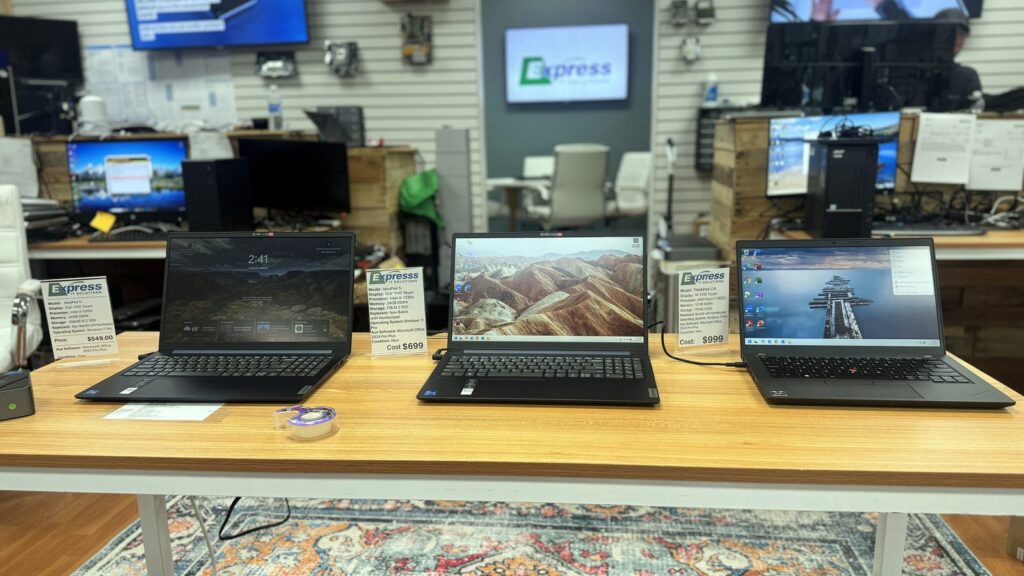
We sell and fix computers from our store at 511 East Genesee St in Fayetteville and have since 2005. We spec the machine with you and sell laptops, desktops, workstations and servers. Dell notebooks: Starting at $499. Nothing is ordered until you say yes, and the specification and price come in writing first. Files, user profiles, printers, saved passwords and email get moved across so the machine is usable the day you get it.
If a repair beats a replacement, we say so; the repair versus replace rule we use is published. For businesses on managed IT, the yearly tech plan and budget covers the hardware refresh, so purchases are planned at known prices rather than discovered in December; see the MSP business packages.
We do not promise that our prices will hold or beat the market; our cost moves with the same market as everyone else’s. What we promise is a straight answer.
What this page does not claim
Every market figure above is a forecast or an estimate from the named source on the named date. We do not know where RAM prices will be next summer, and neither does anyone selling you a computer. We have no relationship with Micron or any memory maker. Nothing here is a quote; your number comes from a conversation and arrives in writing.
Book a time or call (315) 682-6372.
Questions people are asking about RAM and computer prices
Why are RAM prices so high in 2026?
Because AI servers are taking a large share of DRAM production and suppliers are pointing new capacity at them. TrendForce estimated (Aug 25, 2026) that HBM and server modules would take 51 percent of DRAM bit supply in 2026, and conventional DRAM contract prices are projected up another 10 to 15 percent in the fourth quarter (TrendForce, Sept 30, 2026).
When will RAM prices go down?
No published forecast has them falling in 2026 or the first half of 2027. TrendForce (July 30, 2026) expects new DRAM capacity to ramp meaningfully only in the second half of 2027, IDC (July 8, 2026) does not expect the shortage to ease until early 2028, and Micron (Sept 30, 2026) says it has no line of sight to balance.
Will computers be cheaper on Black Friday 2026?
Cheaper than in October on some models, probably. Cheaper than last Black Friday, unlikely. IDC forecasts PC average selling prices up 17 percent in 2026, and Gartner estimated memory costs would lift PC prices about 17 percent against 2025. Expect promotions on specific models and lower specification doorbusters, and compare memory and storage rather than the model name.
Is it better to upgrade RAM or buy a new computer right now?
Price both, then apply the half rule: if memory plus labor costs more than half of a sensible replacement, replace. Memory for older machines is priced in the same tight market, TrendForce (Sept 30, 2026) expects older consumer DRAM prices to keep rising, and many laptops cannot be upgraded at all. If the machine still has a spinning hard drive, an SSD usually helps more than extra RAM.
How much RAM does a business computer need?
16 GB for ordinary office work: a browser, Microsoft 365, Teams or Zoom, accounting software and a line of business application. 32 GB for virtual machines, very large spreadsheets, photo or video editing or CAD, or a laptop that cannot be upgraded and needs to last five years. 8 GB is a false economy for a machine someone uses all day.
Should I buy a computer now or wait until 2027?
If the machine is failing, out of support or costing you time, buy now; the published forecasts have prices rising or holding through 2027, not falling. If it works, you can wait, but because you do not need one, not because a drop is coming. Get the quote in writing and ask how long it holds.